Opening your modern homeowners insurance renewal notice shouldn’t feel like a mandatory financial jump-scare. Yet, as we move through 2026, millions of property owners across the United States are facing exactly that.
The harsh reality? The national average typical home insurance cost has skyrocketed to an unprecedented $2,966 per year. If you reside in highly volatile real estate markets like Florida, that baseline number infamously spirals to a staggering $9,449.
But the real crisis isn’t just the initial sticker shock—it’s what is actively happening beneath the surface of your standard policy features.
The Great Homeowners Insurance Decoupling: Paying More for Less
We are witnessing a quiet, aggressive shift in how modern property insurance operates. National insurance giants are systematically decoupling premium prices from actual protection. Your policy limits might look identical to last year’s on paper, but new exclusions and valuation shifts mean your premium is purchasing a significantly thinner safety net.
If you are a first-time buyer securing a homeowners insurance quote to satisfy a mortgage lender, look out. Lenders only care about protecting their underlying loan balance. They do not care if you have enough money to actually rebuild your life after a major disaster.
Understanding Your Homeowners Insurance Policy Structure
To protect your hard-earned equity, you must understand the structural tier of your policy. The difference between what is covered—and who carries the legal burden of proof—comes down to two primary frameworks:
| Feature | Named Perils (HO-1 / HO-2) | Open Perils (HO-3 / HO-5) |
| Underwriting Scope | Covers only the specific risks explicitly written into the policy (e.g., fire, lightning). | Covers all risks of direct physical loss except those explicitly excluded. |
| Burden of Proof | The Homeowner: You must legally prove a named peril caused the damage. | The Insurer: The carrier must prove a specific exclusion applies to deny the claim. |
| Premium Impact | Lower upfront costs, but leaves you exposed to massive financial ruin. | Higher baseline premium; standard requirement for most mortgage lenders. |
The Invisible Exclusions Hiding in Standard Homeowners Insurance
Most property owners assume a comprehensive house insurance policy protects them against any sudden “Act of God.” They are wrong. Underwriters are aggressively leaning on hyper-specific exclusions to protect corporate balance sheets from climate-driven losses.
Standard policies systematically exclude or heavily restrict:
- The Flooding Fallacy: Surface and subsurface water damage are completely barred. Over 40% of flood damage occurs completely outside designated high-risk zones, yet fewer than 5% of homes carry a standalone flood endorsement. Learn more about regional risk parameters via the Congressional Budget Office (CBO) Risk Analysis.
- Earth Movement: Landslides, sinkholes, mudslides, and minor seismic tremors require entirely separate, expensive additions.
- Maintenance Thresholds: Slow-leak mold and sudden pest infestations are categorized as preventable “wear and tear.” If a pipe leaks silently behind your sheetrock, you own 100% of the financial liability. To mitigate this, check out our guide on preventing hidden water damage.
The $20,000 Roof Trap: Actual Cash Value (ACV)
The most destructive technicality in modern insurance is the widespread transition from Replacement Cost Value (RCV) to Actual Cash Value (ACV) for roofing systems.
An Adjuster’s Reality Check
Imagine your 15-year-old architectural shingle roof suffers severe hail damage. To strip and replace it today costs $30,000. Under an ACV framework, the insurer subtracts steep depreciation based on the roof’s age before cutting a check.
The true evaluation follows this mathematical reduction:
{ACV Payout} = {Replacement Cost} (1 -{Depreciation Percentage})
$10,000 = $30,000 (1 – 0.66)
Even with a premium RCV policy, modern carriers use a multi-step layout known as “Holdback Depreciation.” They cut you an initial, inadequate ACV check. You must fund the remainder of the construction out-of-pocket, complete the work, and submit certified receipts just to claw back your remaining recoverable depreciation. If you lack liquid cash, your structural repairs stall indefinitely.
The Zip Code Breakup: Why “Safe” States Are Premium Targets
Corporate giants like State Farm, Allstate, and AIG are scaling back or exiting high-risk coastal states entirely. To offset these losses and cover soaring global reinsurance costs, national carriers are rebalancing their portfolios. They achieve this by quietly skyrocketing rates in historically “safe” states like Colorado, Iowa, and Minnesota.
When private options dry up, homeowners are forced onto state-backed Insurers of Last Resort (like FAIR plans). These plans provide bare-minimum mortgage compliance, offer stripped-down dwelling coverage limits, and expose you to “emergency assessments”—extraordinary taxes levied on all policyholders to cover post-storm shortfalls.
How to Secure an Affordable Homeowners Insurance Quote
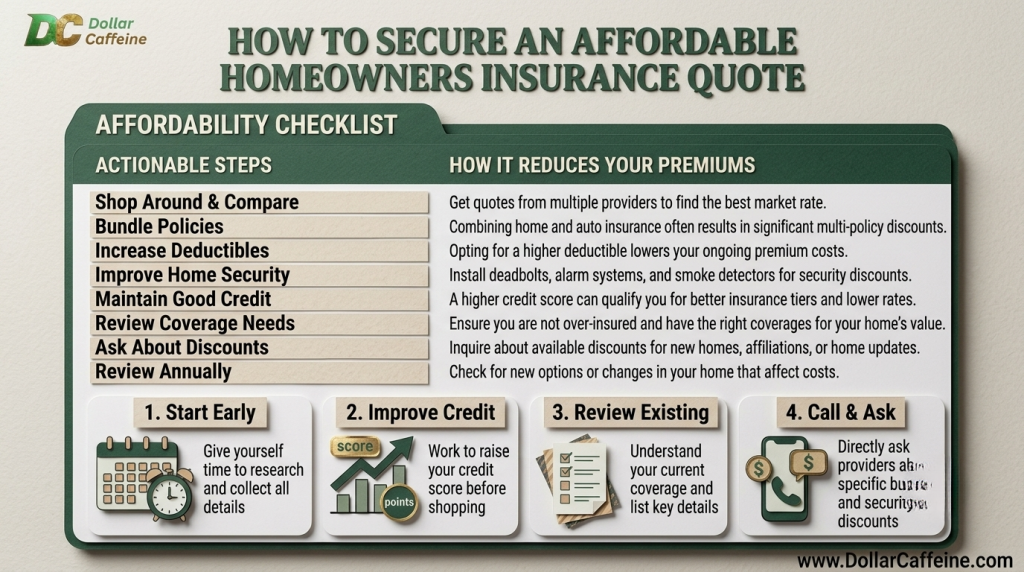
Navigating this volatile market requires an active consumer strategy. You cannot rely on automated online aggregators alone. When comparing top carriers like State Farm homeowners insurance, Allstate home insurance, or Geico home insurance, use these three rules to find cheap home insurance without buying a junk policy:
- Bundle Smarter, Audit Deeper: Combine your auto and property coverage for advanced multi-policy discounts. However, audit the line items carefully to ensure critical personal property coverage limits weren’t secretly dropped to lower the price. Use our interactive insurance coverage calculator to audit your current limits.
- Strategic Deductibles: Shifting from a $500 deductible to a $2,500 deductible can drop your home insurance cost significantly. Just ensure that $2,500 remains completely liquid in a dedicated emergency savings account.
- Hardwire Your Mitigation: Installing impact-resistant shingles, smart leak-detection systems, or clearing a 30-foot defensible space unlocks immediate, structural underwriting credits from premium home insurance companies.
Frequently Asked Questions
What factors drive the typical homeowners insurance cost?
Your premium is dictated by your zip code’s weather patterns, local construction labor costs, the age of your roof, your personal claims history, and your credit-based insurance score.
Is cheap home insurance worth the risk for a first-time buyer?
Rarely. Cut-rate policies achieve low premiums by swapping RCV for ACV, imposing separate 2% to 5% windstorm deductibles, or completely stripping out water backup protection. You can find the insurance at cheap prices fom Nerdwallet.
Why are major insurance companies leaving states like California and Florida?
Escalating climate risks, soaring reinsurance rates, and strict state regulatory caps prevent carriers from raising premiums fast enough to balance their projected catastrophe models.
What is the difference between dwelling coverage and personal property coverage?
Dwelling coverage protects the actual physical structure (walls, roof, framing). Personal property coverage protects the items inside the home (furniture, clothes, electronics). They feature entirely separate limits and valuation structures.
How do modern construction material costs affect my policy?
Inflation and localized labor shortages mean the actual cost to rebuild your home from scratch can far exceed your baseline policy limits. Adding an Extended Dwelling Coverage rider ensures your policy expands by an extra 20% to 50% to absorb post-disaster price spikes.
Conclusion: Building a Resilient Future
Insurance is no longer a “set it and forget it” utility. To truly safeguard your investment in 2026, you must treat your policy as a living financial document. By auditing your structural exclusions, understanding your roof depreciation clauses, and aggressively leveraging modern mitigation discounts, you can protect your equity from the shifting tides of the insurance market.
Ready to see how your current policy measures up? Head over to homeowner insurance vs home warranty real time scenarios to analyze rates from top providers today