If you have spent any time researching real estate investing, you have likely heard of the BRRRR strategy. Popularized over the last decade, this method promises a holy grail for real estate investors: the ability to recycle the exact same pool of capital to buy an infinite number of rental properties.
However, the macroeconomic environment has dramatically shifted. The “easy money” era of 3% mortgage rates is over. Today, executing the BRRRR strategy real estate requires meticulous underwriting, a deep understanding of lender seasoning requirements, and the discipline to find steeper discounts on distressed properties.
In this thorough 2026 guide, we will walk you through the process of what the BRRRR strategy looks like nowadays, present an actual numerical case example, and help you figure out how to overcome the challenges of current finance regulations.
Disclaimer: Real estate investing is risky. This article is meant for educational purposes only. Always seek advice from a licensed CPA, attorney, or financial Ministry before investing.
What is the BRRRR Strategy Real Estate?
BRRRR is an acronym that stands for Buy, Rehab, Rent, Refinance, Repeat.
At its core, it is a value-add real estate strategy. Instead of buying a move-in-ready (turnkey) property at retail price, an investor purchases a distressed property below market value. By renovating the home, the investor “forces appreciation,” instantly increasing the property’s value.
Once a tenant is placed, the investor goes to a bank for a cash-out refinance based on the newly appraised value. The goal is to pull out enough cash to pay off the initial purchase and rehab costs, leaving the investor with a cash-flowing rental property and their original capital back in their pocket to fund the next deal.
Why 2026 Requires a New BRRRR Math
These legacy articles that were penned in 2018-2022 period have always portrayed the BRRRR system as an error-free infinite return machine.However, the truth on the matter becomes slightly different in 2026 owing to two main reasons:
- Higher Interest Rates: With conventional investment property mortgage rates hovering around 6.5% to 7.5%, debt service (your monthly mortgage payment) is significantly higher. This makes it harder for a property to generate positive cash flow once fully leveraged.
- Strict Seasoning Rules: Fannie Mae recently tightened its guidelines. To execute a conventional cash-out refinance based on the newly appraised value, you generally must hold the title (a “seasoning period”) for 12 months.
Because of these hurdles, investors in 2026 must pivot. You must either negotiate much deeper discounts upfront or utilize alternative financing, such as DSCR loans, to bypass conventional lending restrictions. You can Also Change Your Brrrr strategy real estate.
The 5 Steps of the BRRRR Method Explained
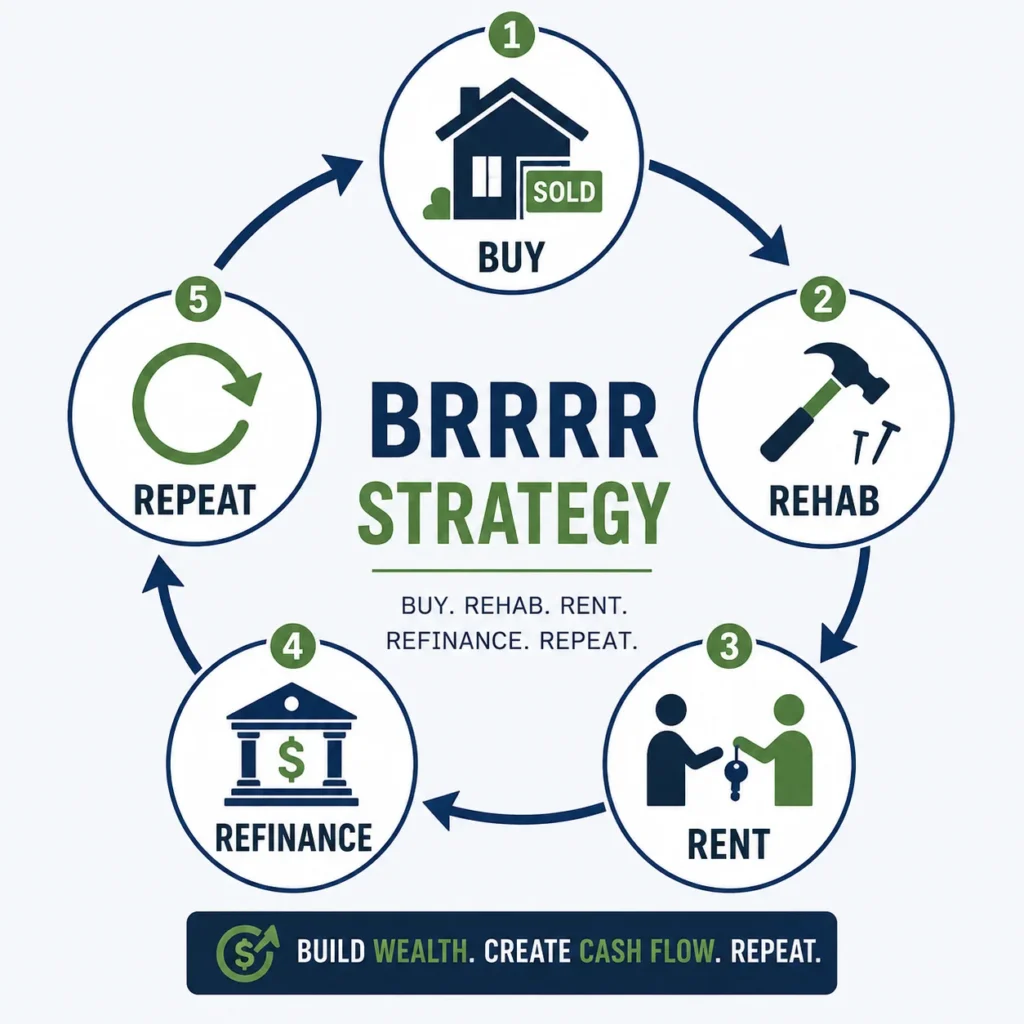
Let’s break down the mechanics of a successful BRRRR property in today’s U.S. market.
1. Buy: Finding the Discount and the MAO Formula
You make your money when you buy. To ensure you have enough equity to refinance later, you cannot overpay. Investors use the 70% Rule to determine their Maximum Allowable Offer (MAO).
The formula dictates that you should pay no more than 70% of the home’s After Repair Value (ARV), minus the estimated cost of repairs.
M AO = (ARV X 0.70) – Estimated Repairs
If a property will be worth $300,000 after being fixed up, and needs $40,000 in work, your MAO is:
MAO = ($300,000 X 0.70) – $40,000 = $170,000
To fund this initial purchase, most investors use short-term capital: cash, Home Equity Lines of Credit (HELOCs), or hard money lenders for BRRRR deals, as conventional banks will not lend on uninhabitable homes.
2. Rehab: Forcing Appreciation Wisely
The rehab phase is where you force appreciation. The goal is not to build your dream home; it is to make the property safe, clean, and durable for tenants.
Focus on high-ROI renovations:
- Updating kitchens and bathrooms (refacing cabinets, quartz countertops).
- Installing durable luxury vinyl plank (LVP) flooring.
- Adding a bedroom or bathroom within the existing square footage.
- Updating essential mechanics (HVAC, roof, plumbing) to reduce future capital expenditures (CapEx).
Tip: Always add a 15% to 20% contingency to your rehab budget for unexpected hidden expenses.
3. Rent: Passing the DSCR Test
Before you can refinance, you need a signed lease. Lenders want proof that the asset generates income. In 2026, your rental income must be strong enough to cover the higher principal, interest, taxes, and insurance (PITI).
Many modern lenders look at the Debt Service Coverage Ratio (DSCR):
DSCR = Gross Monthly / Rent Monthly PITI
Lenders generally want to see a DSCR of 1.20 or higher, meaning the rent is 20% higher than the mortgage payment.You Can Also Find Out Airbnb and Long Term Rental in 2026 which Takes More Money.
4. Refinance: Extracting Your Capital
This is the crux of the strategy. You approach a lender to do a cash-out refinance investment property loan. Lenders typically allow you to borrow up to 70% or 75% of the newly appraised ARV.
If your rehab was successful and you stuck to the math, the new loan will pay off your initial short-term hard money loan and put your down payment cash back into your bank account.
5. Repeat: Scaling Your Portfolio
With your initial capital returned, you move on to the next distressed property, effectively acquiring an income-producing asset for “free” (aside from the time and effort invested).
Real Numbers: A 2026 BRRRR Case Study
Let’s look at how the math actually works in a mid-western U.S. market today, assuming a conservative 75% Loan-to-Value (LTV) refinance at a 7% interest rate.
| Phase | Metric | Dollar Amount |
| Buy | Purchase Price | $120,000 |
| Closing & Holding Costs | $8,000 | |
| Rehab | Renovation Costs | $35,000 |
| Total Capital Invested | $163,000 | |
| Appraisal | New After Repair Value (ARV) | $225,000 |
| Refinance | New Loan Amount (75% LTV) | $168,750 |
| Less: Total Capital Invested | -$163,000 | |
| Less: Refinance Closing Costs | -$4,000 | |
| Outcome | Cash Left in Deal | -$1,750 |
Result: You successfully pulled out almost all of your capital (leaving just $1,750 in the deal).
Now, let’s look at the cash flow on that new $168,750 mortgage at 7%:
- Gross Rent: $1,900/month
- Mortgage (P&I): $1,122/month
- Taxes, Insurance, Property Mgmt & Reserves: $500/month
- Net Cash Flow: $278/month
Even in a high-rate environment, buying at a deep discount allows you to acquire a cash-flowing asset with virtually no money left in the deal. Check Your brrrr cash on cash return Through Our Guide and Using Our Calculator.
DSCR Loans vs. Conventional Mortgages for the Refinance Stage

As mentioned earlier, Fannie Mae’s 12-month seasoning requirement is a massive hurdle. Paying double-digit interest rates to a hard money lender for a full year will destroy your profit margins.
The 2026 solution? DSCR Loans.
A DSCR loan for BRRRR does not look at your personal W-2 income or your debt-to-income (DTI) ratio. It solely underwrites the property’s rental income. More importantly, many DSCR lenders offer 3-to-6 month seasoning periods, allowing you to refinance out of your expensive hard money loan much faster. While DSCR interest rates are typically 0.5% to 1% higher than conventional rates, the speed of capital extraction often makes it the mathematically superior choice.
The Biggest Risks of BRRRR Investing Today
The BRRRR method is highly lucrative, but it is not without strict YMYL (Your Money or Your Life) risks:
- The Low Appraisal: If the appraiser does not agree with your ARV, your 75% LTV loan will be smaller than expected. You will be forced to leave your own cash “trapped” in the deal.
- Rehab Budget Blowouts: Managing contractors is notoriously difficult. A $30,000 budget turning into a $50,000 bill will ruin the deal’s math.
- Holding Costs: Every month the property sits vacant during renovations, you are bleeding money on hard money interest, taxes, and utilities. Speed is your greatest asset.
Practical Action Steps to Take
Should you be prepared to move forward with this approach, this is what you will have to do:
- Identify Your Target Market: It would be very tough to apply the BRRRR approach in HCOL (High Cost of Living) states such as California and New York due to high prices that limit profitability. Identify affordable states with good landlord laws in the Midwest and Sunbelt.
- Assemble Your “Core Four”: You cannot purchase a property without having a solid team behind you. Begin conducting interviews with local realtors, reputable general contractors, property managers, and DSCR lenders.
- Do the Math: Never believe the seller’s estimates on ARV. Utilize a brrrr method calculator for your calculations. Compare prices to estimate your PITI based on 2026 interest rates.
FAQs
What does BRRRR mean in real estate?
Buy, Rehab, Rent, Refinance, Repeat. BRRRR is a way of investing in property, which involves purchasing a distressed asset, increasing its value through renovations, renting it out, and then using the cash out refinance according to the new valuation to recoup your initial investment.
Does BRRRR work in 2026?
Yes, but it will involve purchasing properties at deeper discounts since with the present interest rates being around 6.5%, a new mortgage payment would be much higher, and thus one has to make sure that there is enough income to cover the debt service.
What is 70% rule in BRRRR?
This is a formula stating that an investor should never invest more than 70% of After Repair Value of the property minus estimated repairs. This allows building enough equity in the transaction to have a successful 75% LTV cash out refinance.
How long is BRRRR refinance seasoning period?
The typical seasoning period for a cash-out refinance based on the new valuation in case you purchase from the conventional lender following Fannie Mae rules is 12 months. However, alternative lenders may allow a shorter seasoning period.
Is it possible to skip 12-month seasoning period?
Yes, there is a way to avoid it by using Debt Service Coverage Ratio loans or working with portfolio lenders that require only 3 to 6 months of seasoning.
What is DSCR loan?
DSCR loan is a type of mortgage which considers the investment property’s ability to generate sufficient income to pay off the debt and thus doesn’t consider the W-2 income, tax returns, and personal DTI of the borrower.
What happens if BRRRR appraisal is lower than expected?
In case if the post-renovation appraises for a lower price than initially thought, the lender would base your 75% LTV on the lower number. Thus, you won’t be able to pull 100% of your initial investment, and the capital will be trapped in the transaction.
Is it bad to have some of the money stuck in the BRRRR deal?
No, because while the goal is an infinite return (pulling 100% of cash out), it’s still a much better thing if instead of pulling out everything you’re going to have 5% to 10% of your initial capital invested in a very profitable cash-flowing asset.