Buying a home is easily one of the most significant financial steps you will take. Yet, before you begin scouring listing platforms or scheduling open house tours, there is a fundamental, non-negotiable question you must answer: How much house can I afford?
Determining your absolute financial ceiling is not just about looking at your annual salary. Your homebuying budget is a dynamic puzzle shaped by monthly gross income, recurring liabilities, down payment size, geographical tax rates, and prevailing interest rates.
In 2026, navigating the real estate market requires strategic precision. With the median sales price of American homes hovering near $413,500 and the average 30-year fixed-rate mortgage rate holding around 6.11%, prospective buyers must bypass generic estimates. Leveraging a professional home affordability calculator and understanding how underwriters analyze your financial profile is the only way to shop with confidence and avoid becoming “house poor.”
Quick Answer: The 28/36 Rule of Home Affordability
If you need a reliable baseline immediately, real estate and financial experts recommend utilizing the classic 28/36 rule. Lenders rely on this underwriting standard to assess your risk profile.
- The 28% Limit (Front-End Ratio): You should allocate a maximum of 28% of your gross monthly income to housing-related expenses.
- The 36% Limit (Back-End Ratio): Your total monthly debt obligations—including housing costs and consumer debts—should not exceed 36% of your gross monthly income.
Your total monthly housing costs (often referred to as PITI) include:
- Principal (the loan amount itself)
- Interest (the cost of borrowing the capital)
- Taxes (local property taxes)
- Insurance (homeowners insurance, plus private mortgage insurance and HOA fees, if applicable)
Quick Math Example:
If your household earns $100,000 annually, your gross monthly income is approximately $8,333.
- Applying the 28% front-end rule: $8,333 \times 0.28 =$2,333 maximum monthly housing payment.
- Applying the 36% back-end rule: $8,333 \times 0.36 =$3,000 maximum total monthly debt payments.
The Math Behind Mortgage Approval: Front-End vs. Back-End DTI
To understand exactly how a home affordability calculator evaluates your borrowing profile, we must look at the mathematical underwriting guidelines that lenders use.
The Front-End Debt-to-Income (DTI) Ratio
This ratio measures your gross monthly income against your proposed monthly housing payment (PITI). To calculate your housing ratio, apply this formula:
Housing Ratio = Principal + Interest+ Property Taxes + Homeowners Insurance + PMI + HOA Fees / Gross Monthly Income X 100
The Back-End Debt-to-Income (DTI) Ratio
Lenders are highly focused on your back-end DTI because it incorporates your real-world consumer liabilities (car loans, student loans, minimum credit card payments, child support). This is calculated as:
Total DTI Ratio= Proposed Housing Expense + Recurring Monthly Debts / Gross Monthly Income
Standard DTI Qualification Ranges
| Debt-to-Income (DTI) Ratio | Mortgage Underwriting Outlook |
| Below 28% | Excellent: Maximizes your chances of qualifying for competitive interest rates. |
| 28% to 36% | Very Good: Standard approval territory for prime conventional mortgage programs. |
| 37% to 43% | Acceptable: May require compensating factors like an exceptional credit score. |
| Above 43% | Challenging: Usually requires government-backed loans (like FHA) or major cash reserves. |
While the 28/36 rule remains the safest benchmark, some conventional guidelines allow a back-end DTI up to 45% or even 50% if the borrower has a stellar credit score or significant cash reserves.
Core Factors That Determine How much house can i buy
As Federal Reserve System told Your homebuying potential is determined by a combination of five distinct financial elements.
[Gross Monthly Income] + [Down Payment] + [Credit Score & Interest Rates] + [Existing Debt (DTI)] = Your Buying Power
1. Gross Monthly Income
Your gross income is your total earnings before any taxes or deductions. Lenders rely on gross income because it provides a standardized baseline, bypassing individual tax elections and retirement contributions. This includes base salary, verified bonuses, consistent overtime, self-employment revenue, and rental income.
2. Available Down Payment Capital
The liquid cash you bring to the closing table dictates your loan principal. Putting down 20% completely eliminates the need for Private Mortgage Insurance (PMI), which instantly lowers your monthly carrying costs. However, modern conventional programs allow down payments as low as 3%, while FHA loans start at 3.5%.
3. Credit Score and Mortgage Interest Rates
Your credit score directly dictates the interest rate a lender will offer you. In 2026’s economic landscape, even a tiny 0.5% variance in your mortgage interest rate can shrink or expand your purchasing budget by tens of thousands of dollars over a 30-year term.
4. Existing Monthly Debt Obligations
Every dollar tied up in a minimum credit card payment, auto financing, or student loans directly cannibalizes your maximum approved monthly mortgage payment. Reducing these consumer liabilities is the fastest way to expand your purchasing limit.
Check Our Guide On Home Insurance to check Your Capability and the help you have.
State-by-State Escrow Drag: Taxes and HOA Fees
A property’s base sticker price reflects only a fraction of your real-world monthly obligation. State-level property taxes and Homeowners Association (HOA) assessments introduce massive geographical differences in housing affordability.
Because underwriting systems calculate property taxes and HOA fees directly into your front-end DTI, buying a home in a high-tax state drastically compresses your overall purchase budget.
| State | Average Property Tax Bracket | Real-World Monthly Escrow Impact |
| New Jersey | Very High (~2.49%) | Significantly reduces the maximum mortgage principal you can qualify for on a standard income. |
| Texas | High (~1.60% – 2.15%) | Absent a state income tax, elevated real estate assessments levy heavy monthly escrow demands. |
| Nevada | Low (~0.55%) | Minimizes recurring monthly escrow overages, expanding your raw home purchasing power. |
Additionally, if you purchase a townhouse or condominium with a mandatory $350 monthly HOA fee, that capital is deducted dollar-for-dollar from the amount you can allocate toward your principal and interest payment.According to the Consumer Finance of USA.
Real-World Case Studies: Salary vs. Buying Power
To observe how these rules, debts, and interest rates interact in real-world scenarios, let’s analyze two case studies using a standard 30-year fixed mortgage rate of 6.11%.
Case Study 1: Earning $100,000 per Year (Sarah’s Strategy)
Sarah earns $100,000 annually ($8,333 gross monthly). She has $500 in monthly recurring consumer debt (car payment and student loans) and has saved $90,000 for her down payment and closing costs.
- The Conservative Strategy: Adhering strictly to the 28% front-end ceiling caps Sarah’s housing expense (PITI) at $2,333 per month. By utilizing $80,000 of her savings as a 20% down payment on a $400,000 home, she completely avoids PMI. At a 6.11% rate, her principal and interest sit at roughly $1,940, leaving a comfortable $393 monthly margin for taxes and insurance.
- The Aggressive Strategy: If a lender pushes her back-end DTI limit to 45%, Sarah could technically qualify for a monthly housing payment of $3,250 (assuming her debts remain $500). This would allow her to qualify for a home priced near $495,000, but it leaves her highly vulnerable to financial emergencies.
Case Study 2: Earning $70,000 per Year (David’s Strategy)
David earns $70,000 annually ($5,833 gross monthly). He carries $400 in monthly consumer liabilities and has saved $35,000 for upfront acquisition costs.
- The Conservative Strategy: Adhering to the 28% rule caps David’s housing budget at $1,633 per month. Under current interest rates and factoring in standard tax allocations, this supports a safe purchase price of roughly $215,000 (using a 10% down payment).
- The Aggressive Strategy: Pushing limits to a 43% back-end DTI allows a total monthly debt threshold of $2,508. Subtracting his $400 debt yields a maximum housing payment of $2,108. This budget could technically approve him for a home priced near $265,000, though it reduces his monthly financial flexibility.
5 Practical Ways to Increase Your Buying Power in 2026
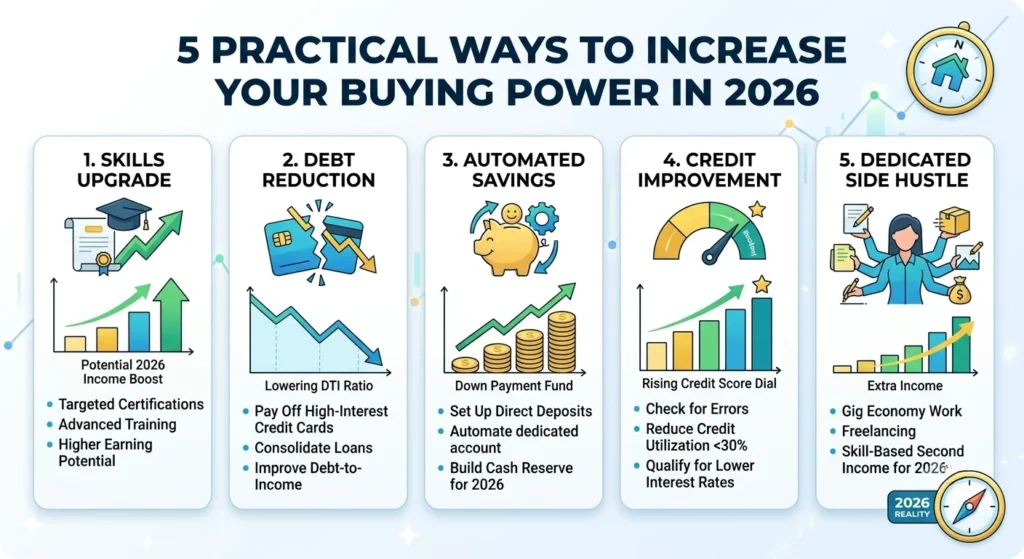
If your initial calculations using our home affordability calculator fall short of property listings in your target neighborhood, you can systematically optimize your financial profile:
- Eliminate Low-Balance, High-Payment Liabilities: Clearing a $300 monthly car payment or a credit card balance instantly reduces your back-end DTI, yielding a substantial increase in your approved mortgage principal.
- Optimize Your Credit Score: Moving your credit score from the “fair” tier (620–679) into the “excellent” tier (760+) can secure you a lower mortgage rate, saving you hundreds of dollars monthly for the exact same loan amount.
- Explore First-Time Homebuyer Programs: Look for state or local Down Payment Assistance (DPA) grants and low-interest loan programs that reduce your initial cash requirements.
- Incorporate Government-Backed Loans: If cash reserves are tight, evaluate FHA loans (which allow a 3.5% down payment and flexible DTI limits) or VA/USDA loans (which offer 0% down options for qualified borrowers).
- Shop Multiple Lenders: Do not accept the first mortgage pre-approval you receive. Compare quotes from local banks, credit unions, and online brokers to secure the lowest possible interest rates and origination fees.
Frequently Asked Questions
Q1: What is the 28/36 rule mortgage guidelines?
The 28/36 rule is a standard financial benchmark used by lenders to calculate housing risk. It advises spending a maximum of 28% of your gross monthly income on housing-related costs (PITI) and a maximum of 36% on total debt obligations (housing expenses plus credit cards, auto loans, and student loans).
Q2: Does a home affordability calculator include property taxes and insurance?
Yes. A comprehensive home affordability calculator integrates principal, interest, local property taxes, homeowners insurance, private mortgage insurance (PMI), and mandatory HOA fees into its final estimates. Simplistic calculators that omit these elements often misrepresent your actual monthly carrying costs.
Q3: Why do lenders look at gross income instead of net income?
Lenders utilize gross pre-tax income because net take-home pay varies widely based on individual tax exemptions, employer healthcare elections, and retirement savings contributions. Gross income provides a standardized baseline for risk underwriting models.
Q4: Does a car loan or student loan payment affect my approved mortgage amount?
Yes. Lenders include all active consumer debts in your back-end debt-to-income calculation. Even if your student loans are currently deferred, underwriters typically factor in a monthly obligation equal to 0.5% to 1% of the total outstanding balance, which reduces your overall buying power.
Q5: Are HOA fees included in my debt-to-income ratio?
Yes. Because homeowners association dues are mandatory and tied directly to the property, lenders treat them as a fixed housing expense, and they are factored into your front-end DTI calculation.
Q6: What is the difference between mortgage pre-qualification and pre-approval?
Pre-qualification is an informal, non-binding estimate of your borrowing power based on unverified information you self-report. Mortgage pre-approval is a formal, written commitment from a lender following a comprehensive verification of your credit history, tax returns, bank statements, and pay stubs.
Final Thoughts
Calculating how much house you can afford requires looking past sticker prices. Long-term, sustainable homeownership is about balancing upfront acquisition costs, localized escrow demands, and ongoing monthly liabilities.
By applying the protective boundaries of the 28/36 rule and using a professional home affordability calculator, you can establish a clear, data-driven budget. To take the next step toward homeownership with absolute confidence, consult with a qualified mortgage professional to secure a formal mortgage pre-approval tailored to your financial profile.