Student Loan Payments in 2026 are changing dramatically under the Working Families Tax Cuts Act. Beginning July 1, 2026, the U.S. Department of Education will introduce the Repayment Assistance Plan (RAP), replacing several existing income-driven repayment programs with a single standardized repayment system. Understanding these changes can help borrowers prepare for higher or lower monthly bills and long-term repayment obligations.
A Legislative Shift Reshaping Student Loan Repayment
Student Loan Payments in 2026 are changing dramatically and This legislation also accelerates the restructuring of existing repayment frameworks, replacing older multi-plan systems with a single standardized income-based formula. Plans like SAVE are being phased out, while RAP becomes the default long-term structure for most borrowers.
Understanding RAP now is critical because it directly affects monthly budgets, long-term debt timelines, and forgiveness eligibility for millions of borrowers. According to ABC News a major shakeup to the federal student loan system affecting millions of borrowers will be Effected.
Student Loan Payments in 2026: What Is the Repayment Assistance Plan (RAP)?
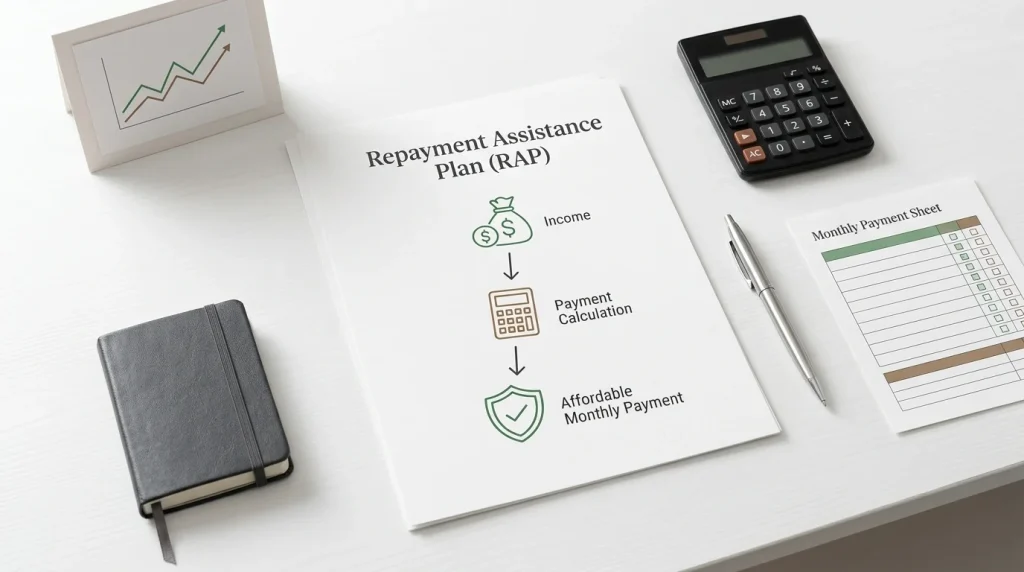
The Repayment Assistance Plan (RAP) is a federally standardized income-driven repayment model introduced under the Working Families Tax Cuts Act. It replaces multiple older repayment programs with a single unified structure tied directly to a borrower’s income.
Instead of choosing between PAYE, IBR, or SAVE, borrowers will be placed into one system that calculates payments using a percentage of adjusted gross income (AGI).
Core principles of RAP:
- Payments based on income brackets (1%–10%)
- Minimum monthly payment of $10
- Annual IRS income verification
- Interest protection to prevent balance growth
- 30-year forgiveness timeline
Who Qualifies for RAP?
Most federal student loan borrowers will be eligible starting July 1, 2026.
Eligible loans:
- Direct Subsidized Loans
- Direct Unsubsidized Loans
- Grad PLUS Loans
- Direct Consolidation Loans
Not eligible:
- FFEL Loans
- Perkins Loans
- Health Education Assistance Loans
Parent PLUS restriction:
- New Parent PLUS loans after July 1, 2026 → NOT eligible
- Older Parent PLUS loans → only eligible if consolidated before cutoff date
How Student Loan Payments in 2026 Are Calculated Under RAP
RAP uses a progressive income bracket system based on AGI.
- $10,000 or less → $10/month
- $10K–$100K → 1%–9% of income
- $100K+ → 10% of income
- $50 deduction per dependent
- Minimum payment always $10
RAP Payment Table
| Income Level | Payment Rate | Monthly Range |
| ≤ $10,000 | Flat | $10 |
| $10K–$20K | 1% | $10–$16.67 |
| $20K–$30K | 2% | $33–$50 |
| $30K–$40K | 3% | $75–$100 |
| $40K–$50K | 4% | $133–$167 |
| $50K–$60K | 5% | $208–$250 |
| $60K–$70K | 6% | $300–$350 |
| $70K–$80K | 7% | $408–$467 |
| $80K–$90K | 8% | $533–$600 |
| $90K–$100K | 9% | $675–$750 |
| $100K+ | 10% | $833+ |
Human Case Study: How RAP Changes Real Life Budgets
To understand how RAP works in practice, consider this real-world scenario.
Take Sarah, a high school teacher in Virginia:
Sarah earns an AGI of $55,000 per year and supports two dependents. She currently has federal student loans under income-driven repayment.
Under the old SAVE system, her payment would have been significantly lower because a large portion of her income would be excluded from calculation, and she may have qualified for a much smaller discretionary income payment.
Under the new RAP structure, her payment is calculated differently:
- 5% of $55,000 = $2,750 annually
- Monthly base payment = $229.17
- Dependent adjustment: $50 × 2 = $100 reduction
- Final RAP payment = $179.17/month
Instead of benefiting from income exclusions like SAVE, Sarah now sees a straightforward income percentage calculation—but her dependents still provide meaningful relief under RAP’s deduction system.
This example shows how RAP simplifies the formula but can increase real monthly obligations for middle-income borrowers.
How RAP Handles Interest
RAP includes an interest protection feature:
- If payment does not cover interest → unpaid interest is waived
- Loan balance will not grow if payments are made on time
- Some payments may also reduce principal by up to $50
This prevents long-term balance inflation, a major issue in older repayment systems.
Married Borrowers and Income Calculation
RAP adjusts based on tax filing status:
Married filing jointly:
- Combined household income used
- Spouse’s student debt considered in calculations
Married filing separately:
- Only individual income counted
- Can reduce payment in some cases
Student Loan Forgiveness Under RAP
1. 30-Year Forgiveness Path
- Remaining balance forgiven after 30 years
- Forgiveness is taxable income
2. Public Service Loan Forgiveness (PSLF)
- 120 qualifying payments required
- RAP payments count toward PSLF
- Forgiveness is NOT taxable
You Can Also Check Complete Guide on How To PAY Off $10,000 in a Year.
RAP vs SAVE: Key Differences
| Feature | SAVE | RAP |
| Income exclusion | Yes (~$35K) | No |
| Payment base | Discretionary income | Full AGI |
| Minimum payment | $0 possible | $10 required |
| Forgiveness timeline | 20–25 years | 30 years |
| Interest handling | Waived | Waived + partial principal support |
Pros and Cons of RAP
Pros:
- Simpler repayment structure
- Predictable income-based formula
- Strong interest protection
- PSLF eligibility retained
Cons:
- No $0 payments
- Higher monthly payments for many borrowers
- Longer forgiveness timeline
- Reduced hardship flexibility
How to Enroll in RAP
Enrollment is expected to open on July 1, 2026 via StudentAid.gov.
Borrowers will:
- Select RAP during repayment update
- Or be automatically assigned based on loan type
- Submit annual IRS income verification
What Borrowers Should Do Before 2026
- 2Reduce taxable income where possible
- 3Update PSLF employment certification
- Review borrowing plans before new caps
- Maintain full payment history records
- Estimate your RAP payment early
Final Thoughts on Student Loan Payments in 2026
The Repayment Assistance Plan simplifies federal student loan repayment into a single income-based system under the Working Families Tax Cuts Act. While it improves transparency and interest protection, it also increases monthly costs for many borrowers and extends the repayment timeline to 30 years.
Borrowers who prepare early—by estimating payments, improving documentation, and adjusting budgets—will be in a stronger position when RAP officially takes effect in 2026.As Student Loan Payments in 2026 shift to the RAP system, preparing early can save money and reduce financial stress.
Frequently Asked Questions About RAP Student Loan Plan
Will RAP replace all existing student loan repayment plans?
Yes, RAP is expected to replace most existing income-driven repayment plans, including SAVE, PAYE, and IBR, as part of the 2026 federal student loan reform.
Can my monthly payment increase under RAP?
Yes, depending on your income level. Since RAP uses full AGI-based calculations, some borrowers may see higher monthly payments compared to older repayment systems.
Is RAP better than SAVE or PAYE?
RAP offers more simplicity and interest protection, but it provides less flexibility than SAVE or PAYE. The best option depends on individual income and financial situation.
What happens if I miss income verification under RAP?
Borrowers are required to submit annual IRS income verification. Missing this step may result in recalculated payments based on standard repayment rules.
Does RAP affect student loan forgiveness eligibility?
Yes, RAP includes two forgiveness paths: 30-year standard forgiveness and Public Service Loan Forgiveness (PSLF), depending on employment type.