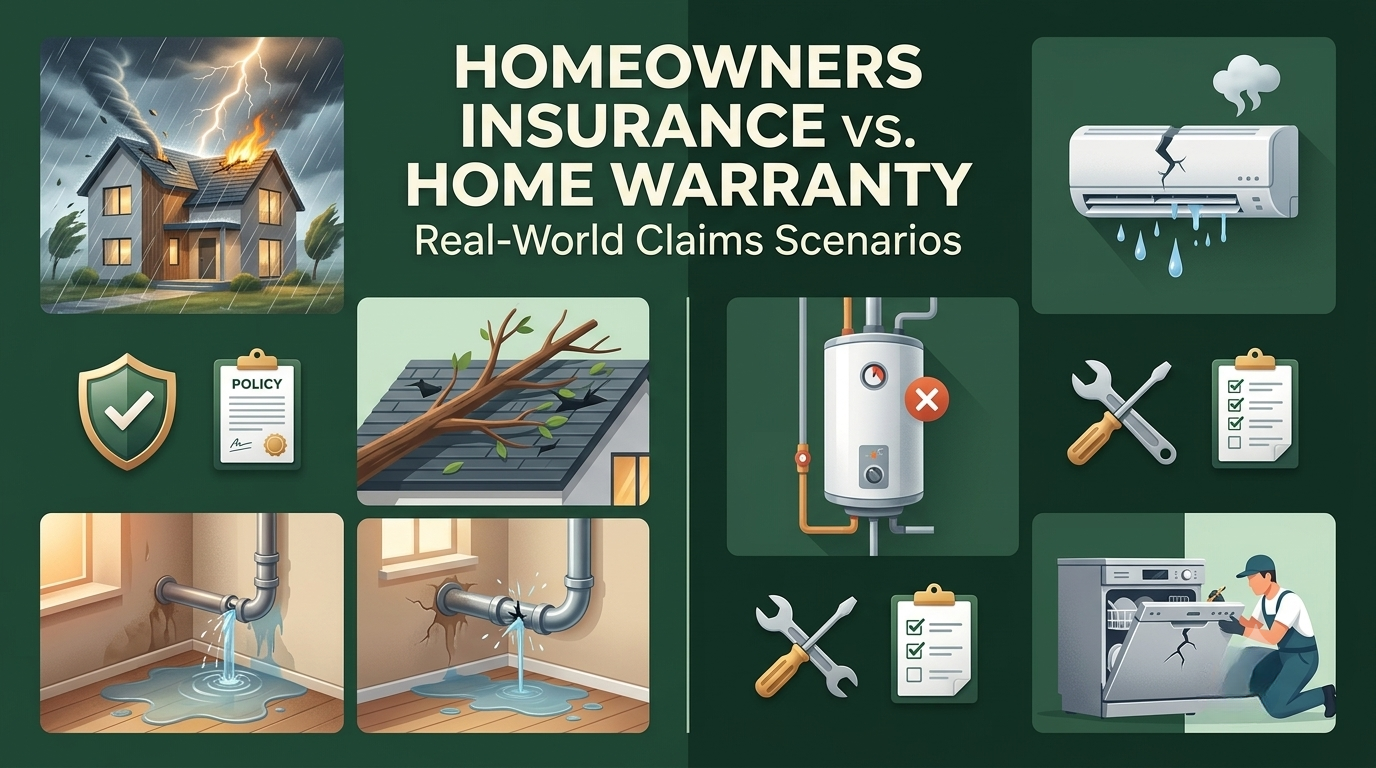
When you are looking at the broad division between homeowners insurance vs home warranty policies, corporate definitions sound clean. Standard financial sites will tell you that homeowners insurance manages sudden, catastrophic accidents, while a home warranty mitigates the day-to-day wear and tear of mechanical appliances.
However, real life does not happen in a clean corporate brochure. Damage occurs in complex, ambiguous ways that blur the line between a maintenance malfunction and a structural catastrophe. To successfully survive the modern real estate landscape, you must pivot away from generic advice. You need to understand how coverage actually fragments when real-world property damage strikes your household.As told by the Federal trade commision.
Scenario 1: Is a Home Warranty Worth It for an Old House With an Aging HVAC?
If you buy or inherit a home with a heating, ventilation, and air conditioning (HVAC) system that is more than 10 to 15 years old, you are sitting on a financial time bomb. Navigating this scenario highlights the foundational friction point of homeowners insurance vs home warranty logic.
The Insurance Reality
Your standard homeowners insurance policy provides zero coverage for an old HVAC unit that stops heating or cooling due to normal aging. Mechanical degradation is considered a fundamental maintenance responsibility. Insurance will only step in if an external force such as a fallen tree crushing the outdoor condenser unit or a fire burning down the home—destroys the system.
The Home Warranty Reality
This is the primary reason people purchase home service plans. If your old HVAC system fails due to gradual mechanical wear and tear, a home warranty is designed to cover the repair or provide a full unit replacement.
The 2026 Fine Print Catch:
You must look out for pre-existing conditions and maintenance records. If a warranty technician inspects your broken, 18-year-old furnace and discovers that the previous owner skipped annual cleanings for a decade, leaving a visibly rusted heat exchanger, the warranty provider may deny the claim under a “lack of maintenance” exclusion clause.
A home warranty is highly worth it for an old house with an aging HVAC, provided you have documented proof that the system is currently working when your contract takes effect.
Scenario 2: Does Homeowners Insurance Cover Plumbing Lines Broken by Tree Roots?
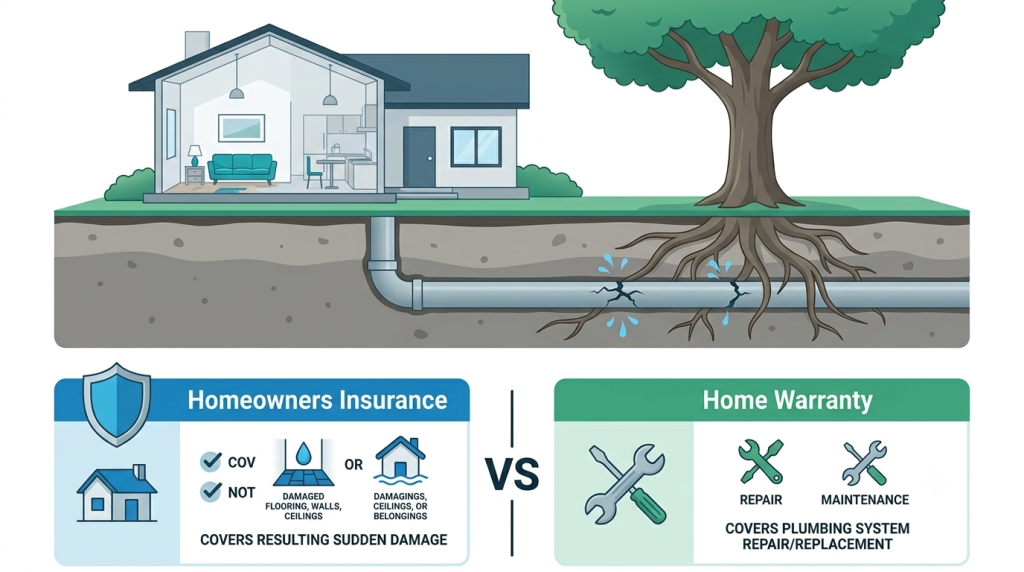
You notice your toilets are backing up into your showers, and a plumbing camera inspection confirms that roots from the oak tree in your front yard have penetrated and shattered your main underground sewer lateral line.
The Insurance Reality
A standard homeowners insurance policy explicitly excludes underground tree root invasion. Because tree root growth is an incredibly slow, gradual process, insurance adjusters classify it as a maintenance issue rather than a sudden, accidental event.
However, there are two crucial exceptions you must know:
- Water Backup Endorsement: If you purchased an optional “Water Backup and Sump Pump Overflow” rider, your insurance will pay to clean up the toxic water damage inside your home, replace ruined bathroom flooring, and dry out your drywall. However, they still will not pay a dime to fix the broken underground pipe itself.
- Service Line Coverage: To get the actual pipe fixed by insurance, you must add an optional Buried Utility Line Endorsement to your policy before the damage happens. This specific add-on covers the heavy excavation costs required to dig up your yard and swap out line segments broken by root intrusion.
The Home Warranty Reality
Most standard home warranties cover internal plumbing line clogs and clear basic lateral blockages within your home’s foundation shell. However, they explicitly exclude structural external lines cracked by natural vegetation or root growth.
- Neither standard insurance nor a basic warranty covers a main line broken by tree roots out of the box. You must proactively acquire a Service Line Endorsement on your insurance policy or buy a dedicated Sewer Line Warranty add-on.
Scenario 3: Home Warranty vs. Insurance After a Lightning Strike Power Surge
A thunderstorm strikes your neighborhood, hitting a nearby transformer line. A massive electrical power surge runs directly through your home’s wiring, frying the computer control boards on your smart refrigerator, your luxury range oven, and your HVAC system.
This is the ultimate intersection of homeowners insurance vs home warranty rules.
The Insurance Reality
Lightning is recognized by insurance providers as a classic covered peril (an act of God). Because the damage was sudden, violent, and external, your homeowners insurance policy is responsible for replacing your fried personal belongings and repairing damaged electrical panels.
The downside? Your insurance claim is subject to your standard policy deductible. If your deductible is set to $1,500, and the surge causes $2,000 worth of total appliance damage, your insurance provider will only pay you a net sum of $500. Additionally, filing an insurance claim can cause your future annual premiums to spike.
The Home Warranty Reality
Home warranties generally contain explicit exclusions for “Acts of God,” weather events, lightning, and external power surges.check out our Guide on How to buy your First house in high interest market in 2026. If a warranty technician comes out and verifies that an appliance’s motherboard was scorched by a high-voltage external power surge rather than standard internal mechanical failure, the claim will be denied, and you will be directed back to your insurance company.
- For a lightning surge, homeowners insurance is your primary path to financial recovery. Use your home warranty only if you can prove that an appliance failed due to ordinary component wear and tear completely independent of the weather event.
Summary Matrix: How Claims Split Across Specific Real-World Scenarios
| Specific Property Issue | Primary Cover Option | The Critical Condition / Friction Point |
| Old HVAC failure (Age 15+) | Home Warranty | Denied if there is clear evidence of historical owner neglect. |
| Sewer lateral shattered by roots | Service Line Rider | Excluded from standard insurance and basic home warranties. |
| Lightning surge frying panels | Home Insurance | Subject to your deductible; home warranties exclude acts of God. |
You can also check out the National Association of Insurance Commissioners (NAIC) to learn how to audit your active property policies
Frequently Asked Questions
Q1: Can I use my home warranty in repairing my aged HVAC without any history of maintenance records?
Yes, provided that the HVAC is still functioning well and passes the home inspection at the time of your warranty contract. But if the technician discovers that there are already existing issues like rust and other failures that have been present for quite some time now, your warranty provider can easily deny the repair claim.
Q2: Can I file a claim under home insurance if tree roots make my pipe burst and require digging of my lawn?
Only if you have included Service Line Endorsement in your homeowners policy coverage. If not, your ordinary homeowners insurance policy does not cover any excavation of underground pipes due to tree roots damage.
Q3: In case my electrical surge from lightning damages all my kitchen appliances, what will be my first step?
First, call an electrician to check the damage of the surge on your home’s electrical panel, and afterward, contact your homeowners insurance agent. Do not call the home warranty provider right away, as they will automatically deny your claim.