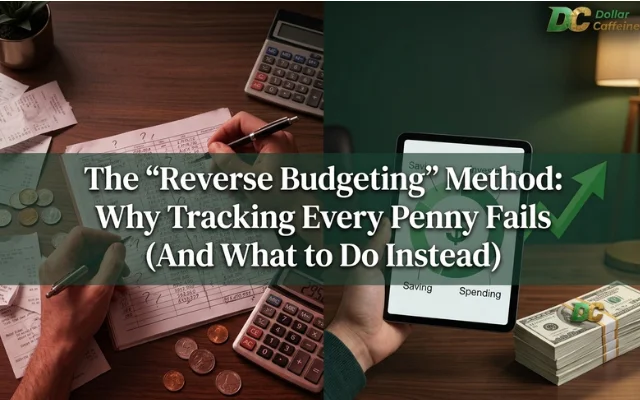
If you are tired of losing control of your finances by week two of every month, learning how the Reverse Budgeting Method works can transform your financial life.
We’ve all been there. You open a finance app or a complex spreadsheet, determined to track every single transaction for the month. You categorize your lattes, your groceries, and your streaming services. For about two weeks, you feel in control. Then, life happens. You forget to log a purchase, you get busy, and suddenly, the budget is ignored.
The guilt sets in, and you give up.
Here’s the reality: financial discipline shouldn’t feel like a part-time job. If you find yourself constantly battling spreadsheets and failing to stick to a rigid spending plan, it might not be a lack of willpower. It’s likely a flawed process.
It’s time to talk about the Reverse Budgeting Method. It shifts the focus from limiting what you spend to guaranteeing what you save.
What is Reverse Budgeting?
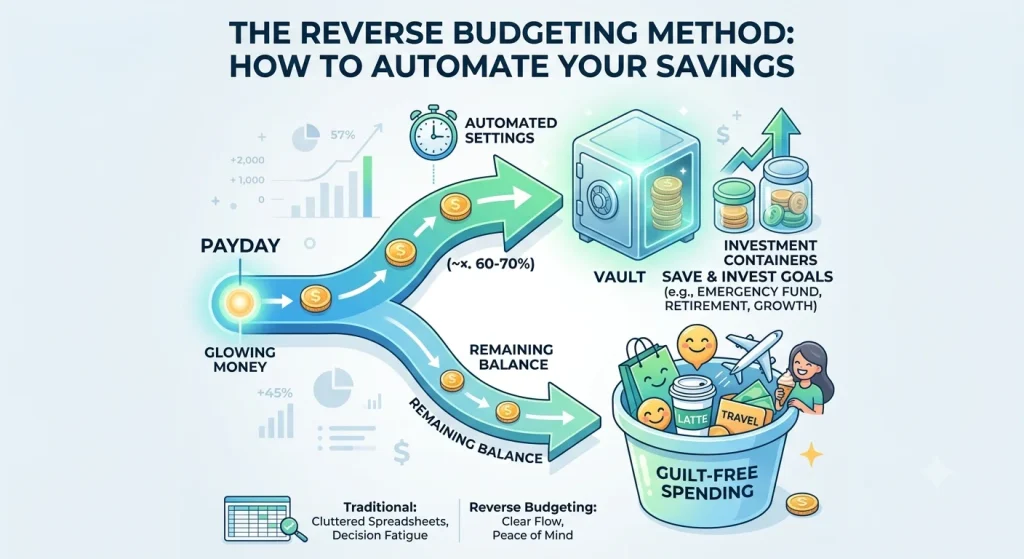
Reverse Budgeting is a strategy where you prioritize your savings and investment goals immediately after getting paid, rather than trying to save what’s left at the end of the month. Instead of tracking every penny you spend, you automate your savings first, then spend the remaining balance freely without guilt.
Why Traditional Budgeting Usually Fails
Most people approach money like a diet: they try to restrict themselves. They set a limit for “entertainment” or “dining out” and try to stay under that number.
This fails for two main reasons:
- Decision Fatigue: When you have to make a choice about every small purchase—”Is this coffee within my $40 monthly entertainment budget?”—you burn out. You have a finite amount of mental energy each day. Budgeting shouldn’t consume it.
- The “Scarcity” Mindset: Traditional budgets often focus on what you can’t do. When you focus on deprivation, you’re more likely to “binge” on spending later because you feel restricted.
Reverse budgeting flips the script. It says: “If I save my goals first, it doesn’t matter how I spend the rest, because I’ve already ‘won’ for the month.”.You can also check out Our Guide How To Create a Monthly Budget On Low Income
How the Reverse Budgeting Method Works
ITo get started with the Reverse Budgeting Method, you don’t need a PhD in finance. You just need three simple steps to get the engine running.
1. Know Your Numbers
Before you automate anything, you need to know how much you earn and what your non-negotiable bills are. You aren’t tracking your coffee or your shopping trips here. You are just identifying the “must-haves”: rent or mortgage, utilities, insurance, and minimum debt payments.
2. Set Your “Non-Negotiable” Savings
Determine exactly how much you want to save or invest each month. Whether it’s 10%, 20%, or a flat dollar amount, this is your priority. This is the money that builds your future.
3. Automate the Process
This is the most critical step. Set up an automatic transfer from your checking account to your savings or investment account to happen the same day you get paid.
By the time you open your banking app to see what’s available for spending, the savings goal is already gone. You don’t have to think about it. The money that remains in your checking account is your “guilt-free” spending money. If you spend it all by the 25th of the month, that’s your limit. If you have some left over? Great, you can put it toward a vacation or a treat.
Reverse Budgeting vs. Traditional Budgeting
| Feature | Traditional Budgeting | Reverse Budgeting |
| Focus | Tracking every expense | Prioritizing savings |
| Effort | High (daily/weekly logging) | Low (set up once) |
| Mental Load | Causes decision fatigue | Frees up mental space |
| Feel | Restrictive | Guilt-free |
| Best For | Extreme debt repayment | Long-term growth & balance |
Practical Example: A Scenario with “Sarah”
Let’s look at how the Reverse Budgeting Method handles Sarah’s finances. Sarah earns $4,000 take-home pay every month. Her “must-have” bills (rent, utilities, insurance) total $1,800. Sarah decides she wants to save/invest $1,000 per month for her future goals.
Sarah earns $4,000 take-home pay every month.
Her “must-have” bills (rent, utilities, insurance) total $1,800.
Sarah decides she wants to save/invest $1,000 per month for her future goals.
- Total Pay: $4,000
- Bills: -$1,800
- Automated Savings: -$1,000
- Remaining for Spending: $1,200
Sarah sets up an automatic transfer for $1,000 on payday. The remaining $1,200 is hers to use however she likes. She doesn’t need to log her Netflix subscription or her takeout meals. As long as she doesn’t pull from the savings account, she hits her goals every single month without fail.
But here’s the nuance: If Sarah notices she’s hitting zero in her checking account by the 20th of the month consistently, she doesn’t need a spreadsheet to tell her she’s spending too much. She just needs to adjust her lifestyle or lower her “must-have” bills.
Does Reverse Budgeting Work for Everyone?
While the Reverse Budgeting Method balances your future and your present effortlessly, this isn’t a magic wand for every situation.
When it works best:
If you have a steady income, reasonable expenses, and your primary goal is building wealth for the future, this is an incredible way to reduce stress.
When you might need a traditional budget:
If you are currently in crushing debt (high-interest credit cards), you might need more granularity. When you are in a “debt emergency,” tracking every penny can help you find leaks you didn’t know existed. Sometimes, you need to see exactly where your money is going to find the extra cash to pay off those high-interest balances.
Frequently Asked Questions (FAQ)
What if I have an irregular income?
Reverse budgeting is actually great for freelancers. Instead of a flat dollar amount, use a percentage. If you have a high-earning month, your savings automatically increase. If you have a leaner month, your savings decrease proportionately. It keeps you consistent without the stress of rigid fixed numbers.
Is it safe to spend everything left over?
It depends on your personality. If you are naturally prone to overspending, you might want to split your “spending” money into two buckets: a “needs/bills” bucket and a “fun” bucket. Just remember: as long as your automated savings transfer happens, you’ve hit your primary financial objective.
How do I know if I’m saving enough?
A good rule of thumb is the 50/30/20 rule, but don’t treat it like a law. Aim to save 20% of your income. If you can save more, do it. If you’re just starting, 5% is better than nothing. The key is to start automating something today.
Disclaimer: This article is for educational purposes only and should not be considered personalized financial advice. Investing involves risk, including the potential loss of principal. Always consult with a certified financial planner or tax professional before making major decisions regarding your personal finances. According to Finra.org
Does this help you understand how to automate your wealth-building? Let me know if you want to dive into the next logical step—how to allocate that automated savings into specific investment buckets!