
You managed to negotiate an amazing salary of $70,000 and you have signed your offer letter. Finally, the day comes and you receive your paycheck through direct deposit. But you realize something is wrong and all your calculations don’t match. Your paycheck is much smaller than expected. Then you want to know about gross vs net income which is the best.
Welcome to the reality of the American payroll system.
On the other hand, the distinction between gross income and net income is based on the fact that Gross Income is the total amount earned by the employee prior to any deduction, while Net Income is the actual earnings of the person. Thirty percent of the total income of the employee goes towards deductions like FICA, Federal Income Tax, State Tax, and others.
This guide is going to walk you through exactly what gross versus net income means, decipher those pesky acronyms found on your paystub, and show you how to figure out just how much you’re really taking home each month.
Dollar Caffeine Interactive Tool: Want to skip the math? Scroll to the top of this page to use our 2026 Net Pay Calculator to instantly estimate your take-home pay based on your state and filing status.
What is the Difference Between Gross vs Net Income?
To master your personal finances, you must understand these two foundational terms.
Gross income is the first line figure.Gross income is described as the total income earned without taking into account any deductions for taxes and other expenses. As an illustration, when someone is paid $100,000 annually as salary, his gross income will be exactly $100,000. However, if one earns $25 per hour working for 40 hours weekly, his gross income for that week will be $1,000.
Net Income is the bottom-line number. Often referred to as “take-home pay,” this is the actual liquid cash deposited into your checking account after all mandatory taxes and voluntary benefits have been stripped away. Net income is the money you actually have available to pay your rent, buy groceries, and fund your lifestyle.
Why Is My Paycheck So Low? (The 30% Reality)
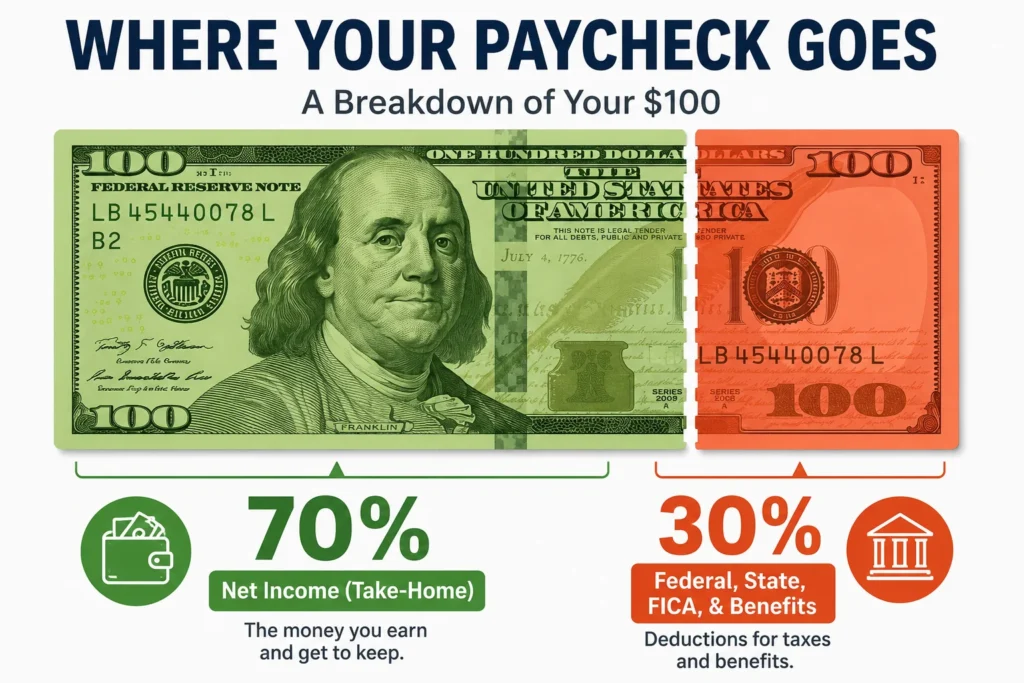
A common shock for young professionals and freelancers transitioning to W-2 roles is realizing that 25% to 30% of their gross pay vanishes before they ever see it.
You are not being robbed; you are fulfilling federal and state tax obligations, while likely paying for benefits. Paycheck deductions explained simply: the IRS requires employers to withhold taxes as you earn the money, rather than trusting you to save up and pay a massive bill at the end of the year.
If you make a $100k salary after taxes and deductions, you might only take home $68,000 to $75,000, depending heavily on whether you live in a high-tax state like California or a zero-income-tax state like Texas.
Paycheck Deductions Explained: Decoding the Alphabet Soup
If you look at your pay stub—whether it is from ADP, Gusto, or Paychex—you will see a list of cryptic abbreviations. Let’s decode where your money is actually going.
What is FICA? (OASDI and FED MED/EE)
When people ask, “what is FICA tax on my paycheck?“, they are asking about the Federal Insurance Contributions Act. FICA is a mandatory federal payroll tax that funds two massive government safety nets:
- OASDI (Social Security): Old-Age, Survivors, and Disability Insurance. This eats 6.2% of your gross pay (up to an annual wage limit).
- FED MED/EE (Medicare): This funds the federal healthcare program for seniors and takes 1.45% of your gross pay (with no upper wage limit).
Combined, FICA instantly shaves 7.65% off your paycheck. You cannot opt out of this tax.
Federal and State Income Taxes
Next up is income tax withholding, determined by the W-4 form you filled out on your first day of work.
- Federal Withholding: Based on your tax bracket and filing status (single, married, dependents).
- State & Local Taxes: This varies wildly. If you live in Florida or Nevada, your state tax deduction is 0%. If you live in New York City, you are paying high state taxes plus a local city tax.
Note on Bonuses: Many employees wonder why their bonus checks seem exceptionally low. The IRS.gov classifies bonuses as “supplemental wages,” which are typically subjected to a mandatory flat 22% federal withholding rate, drastically shrinking the net payout.
Pre-Tax vs. Post-Tax Deductions: Keeping More of Your Money
Not all deductions are bad. In fact, understanding pre tax vs post tax deductions is the secret to legally lowering your tax bill.
Pre-Tax Deductions are taken out of your gross pay before federal and state income taxes are calculated. By lowering your overall taxable income, you pay fewer taxes. Examples include:
- Traditional 401(k) contributions
- Health, dental, and vision insurance premiums
- Health Savings Account (HSA) and Flexible Spending Account (FSA) contributions
- Commuter benefits
Post-Tax Deductions are taken out after taxes have been applied. They do not lower your tax liability. Examples include:
- Roth 401(k) contributions
- Wage garnishments (like unpaid child support or back taxes)
- Union dues
The Gross to Net Formula: How to Calculate Net Income from Gross Pay
If you want to run the numbers manually and want to know gross vs net income which is best instead of using a w2 tax calculator, you can use the standard gross to net formula:
Net Income = Gross Income – Pre-Tax Deductions + Mandatory Taxes + Post-Tax Deductions
Step-by-Step Example:
Let’s say your Gross Pay for the month is $5,000.
- Subtract Pre-Tax Deductions: You contribute $300 to your 401(k) and pay $200 for health insurance. Your new taxable gross is $4,500.
- Calculate & Subtract Taxes: Using your $4,500 taxable income, your employer calculates your Federal, State, and FICA (7.65%) taxes. Let’s estimate this combined tax burden at $900.
- Subtract Post-Tax Deductions: You contribute $100 to a Roth 401(k).
- Final Math: $5,000 – $500 (pre-tax) – $900 (taxes) – $100 (post-tax) = $3,500 Net Income.
Should I Budget Based on Gross or Net Income?
This is a critical rule of personal finance: Always budget based on your Net Income. If you try to apply the famous 50/30/20 budget rule (50% Needs, 30% Wants, 20% Savings/Investing) to your gross income, you will instantly overspend. Your gross income is ghost money; it belongs partly to the IRS. Your net income is your true, liquid spending power. Its your decision what to choose gross vs net income.
Exception: When you apply to rent an apartment, landlords will almost always look at your Gross Income to see if you meet the industry standard requirement of earning three times the monthly rent.
Practical Next Steps
Stop guessing where your paycheck is going. Take these immediate steps today:
- Audit Your Pay Stub: Log into your company’s payroll portal (like ADP) and locate your latest pay stub. Identify your OASDI, Medicare, and Federal withholdings.
- Review Your W-4: If your net pay is too low, but you get a massive $4,000 tax refund every April, you are giving the government a free loan. Use the IRS Tax Withholding Estimator to adjust your W-4 so you get more money in each paycheck.
- Maximize Pre-Tax Benefits: If you want to legally lower your tax burden, increase your 401(k) or HSA contributions. It reduces your taxable income while building your long-term wealth.
You Can also check How to protect Side hustle income in 2026 for getting paychecks faster.
FAQs: The Ultimate Paystub Decoder
What is gross income?
It is the total sum of earnings made by an employee from an employer before any taxes and other benefits are deducted from a salary check.
What is net income?
Net income, also referred to as ‘take-home pay’, refers to the actual income that remains after mandatory and optional payments are made from the total gross income earned.
Why is 30% of my pay gone?
Usually, 20% to 30% of gross income is used in paying the Federal Income Tax, State Income Tax, FICA (Social Security and Medicare at 7.65%), and optional deductions such as health insurance and contribution to a pension plan.
What is FICA in my paycheck?
FICA stands for Federal Insurance Contributions Act. It refers to a mandatory 7.65% payroll tax split evenly between Social Security (6.2%) and Medicare (1.45%).
How can I calculate net pay from gross pay?
The process of computing net pay from gross pay involves first calculating any pre-tax deduction (such as health premium). Secondly, deducting the estimated amount of federal, state, and FICA taxes, and thirdly, any post-tax deductions.
When applying for an apartment, should I include gross income or net income?
In most cases of gross vs net income, landlords use gross income when making sure an applicant has the minimum required gross income three times the rent payment.
From gross or net pay, do 401(k) contributions get made?
In the case of traditional 401(k) contributions, it gets made from gross pay (pre-tax), hence reducing one’s total taxable income for the year. In the case of Roth 401(k) contributions, it gets made after tax.
What does OASDI stand for in my paycheck?
OASDI stands for Old-Age, Survivors, and Disability Insurance, which refers to the full official name of the Social Security tax deduction.
How will changing my W-4 impact my net pay?
A change in W-4 alters the amount of federal tax deducted by your employer. A reduction in number of dependents will reduce your net pay (and increase future refund). An increase in the number of dependents will increase your net pay.
Is health insurance pre-tax?
In most cases, health, dental, and vision insurance premiums offered by employers get deducted from pre-tax incomes.