If you are evaluating a new real estate deal in 2026, the gross rent numbers probably look fantastic on paper. But as any seasoned investor will tell you, the gap between projected cash flow and actual cash flow is often filled with rental property hidden expenses.
In today’s normalized housing market, where interest rates demand precision, missing a single expense category in your underwriting can turn a performing asset into a massive liability. To protect your bottom line, you must move beyond the basic mortgage, taxes, and insurance calculations.
Whether you are a novice landlord or scaling a multi-family portfolio, understanding these unexpected rental property costs is the ultimate key to sustainable wealth. Below, we break down the 15 hidden costs of owning rental property that you absolutely must budget for.
The 15 Rental Property Hidden Expenses Every Investor Must Budget For
To keep your underwriting tight, we have categorized these expenses into three distinct groups By IRS .Gov. Use this table as your ultimate landlord budget checklist:
| Operational Leaks | Financial & Legal | The Unpredictable |
| 1. Seasonal Snow & Landscaping | 6. Eviction Attorney Fees | 11. Tenant Turnover Costs |
| 2. Routine Pest Control | 7. LLC Renewal & Compliance | 12. Extended Vacancy Utilities |
| 3. HVAC Servicing & Filters | 8. CPA & Bookkeeping Costs | 13. HOA Special Assessments |
| 4. Appliance Maintenance | 9. Property Tax Reassessments | 14. Unplanned Capital Expenditures |
| 5. Property Management Fees | 10. Private Mortgage Insurance | 15. Emergency Remediation |
Part 1: Operational Leaks (The Day-to-Day Drain)
These are the most common rental property hidden expenses that slowly reduce your monthly cash flow if you fail to budget for them properly.
1. Seasonal Landscaping and Snow Removal
In many US municipalities, the landlord is legally responsible for keeping sidewalks clear of snow and ice to prevent slip-and-fall lawsuits. Even if your lease states the tenant handles lawn care, you will inevitably need to pay for professional tree trimming, gutter cleaning, and leaf removal to protect the property’s exterior.
2. Routine Pest Control
Tenants will call you the moment they see an ant. Pre-emptive quarterly pest control is far cheaper than dealing with a full-blown termite or bed bug infestation later.
3. HVAC Servicing and Filter Replacements
HVAC systems are the lungs of your property. Relying on tenants to change air filters every 90 days is a recipe for disaster. Budget for bi-annual professional HVAC servicing to extend the lifespan of your $8,000 unit.
4. Appliance Maintenance
Refrigerators leak and dryer belts snap. Even if you supply brand-new appliances, budget for at least one $150 to $300 service call per unit, per year.
5. Hidden Property Management Fees
Most investors budget for the standard 8% to 10% monthly management fee. What they forget to budget for are the extras: leasing fees (often equivalent to one month’s rent), lease renewal fees, maintenance markups, and onboarding costs.
Part 2: Financial & Legal Blind Spots
Many investors overlook these rental property hidden expenses because they don’t appear during the initial property tour.
1. Eviction Attorney Fees and Court Costs
Even with rigorous tenant screening, evictions happen. In the US, the legal process can drag on for months. Between filing fees, process servers, and attorney retainers, a single eviction can cost upwards of $3,000—not including the lost rent.
2. LLC Renewal Fees & Corporate Compliance
If you hold your property in an LLC for asset protection, you must pay annual state renewal fees. In states like California, the annual franchise tax fee is a mandatory $800, regardless of whether your property made a profit.
3. CPA and Bookkeeping Costs
Real estate tax law is highly complex. Properly deducting IRS Schedule E expenses and navigating depreciation recapture requires a specialized real estate CPA. Expect to pay $500 to $1,500 annually for professional tax preparation.
4. County Property Tax Reassessments
This is a massive hidden expense. If you buy a property that has not been sold in 20 years, the current property taxes are likely artificially low. Upon closing, the county will reassess the property at the new purchase price, potentially doubling your tax bill in year two.
5. Private Mortgage Insurance (PMI)
If you leveraged your investment with less than 20% down, your lender will attach PMI to your monthly payment. This protects the bank, not you, and adds zero equity to your investment.
Part 3: The Unpredictable (Vacancy & Major Repairs)
The most destructive rental property hidden expenses are the ones you cannot schedule on a calendar.
1. Tenant Turnover Costs
When a tenant leaves, the meter starts running. Tenant turnover costs involve deep cleaning, fresh paint, re-keying locks, carpet shampooing, and staging. Even a tenant who leaves the property in “good condition” will cost you hundreds of dollars to prep for the next showing.
2. Extended Vacancy Utility Costs
When the property is empty, the bills do not stop. You must keep the electricity on for showings and the heat running to prevent frozen pipes. Investors often ask, does insurance cover vacancy? The harsh reality is no. Standard landlord insurance policies do not cover lost rent or utility bills between tenants unless the vacancy was caused by a covered disaster (like a fire).
3. HOA Special Assessments
If your rental is a condo or in a planned community, you likely budgeted for the monthly HOA fee. But how to factor HOA special assessments into your budget is trickier. If the community needs a new roof or pool repair, the HOA can levy a sudden, mandatory assessment of thousands of dollars on all owners. Always review the HOA’s reserve funds before buying.
4. Unplanned Capital Expenditures (CapEx)
Replacing a roof, repaving a driveway, or installing a new water heater are not standard maintenance—they are Capital Expenditures. Estimating capital expenditures for an older rental property is crucial. If a home is 30 years old, you must aggressively fund your CapEx reserves from day one, as major systems will fail sequentially.
5. Emergency Remediation (Mold & Water)
A slow drip under a kitchen sink can rot subflooring and spawn toxic mold. Remediation requires specialized contractors and can force you to pay for your tenant’s temporary hotel stay while the property is repaired.
Crucial Mathematical Frameworks for Landlords
To ensure you are fully protected against these 15 cash flow killers, successful real estate investors rely on proven mathematical rules.
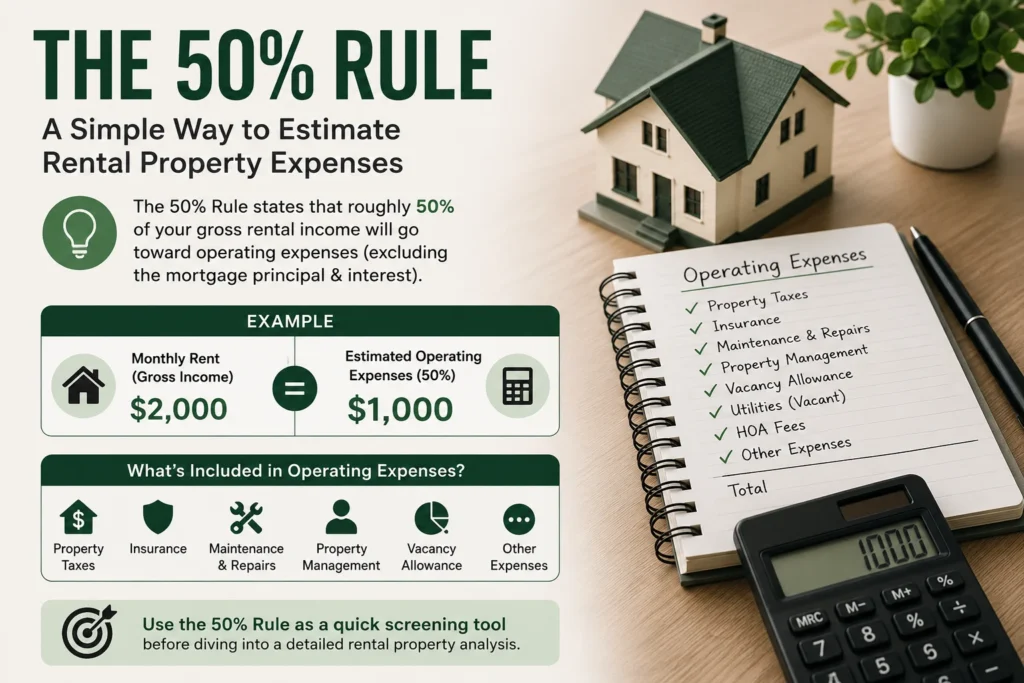
The 50% Rule
The 50% Rule is one of the easiest ways to estimate rental property hidden expenses before making an offer.
If you are rapidly analyzing deals and wondering, what is the 50 percent rule for rental property expenses, it is an incredibly effective rule of thumb. It states that, on average, 50% of your gross rental income will go toward operating expenses (taxes, insurance, maintenance, property management, vacancy) excluding the mortgage principal and interest. If a property rents for $2,000 a month, assume $1,000 will vanish to expenses before you even pay the bank.
The 1% Maintenance Rule
When estimating general wear and tear, budget 1% of the property’s total value per year for routine maintenance. For a $300,000 rental property, you should expect to spend roughly $3,000 annually just keeping the asset in baseline condition.
Final Thoughts: Protect Your Cash Flow
Profitable real estate investing is not about hoping nothing breaks; it is about underwriting the deal so accurately that you remain profitable when things break. By proactively budgeting for these rental property hidden expenses, you instantly transition from a stressed landlord to a sophisticated real estate investor.
Do not let hidden costs of owning rental property catch you off guard. Build your emergency reserves, Before purchasing your next investment, use our Rental Property Calculator to estimate every rental property hidden expense and avoid costly surprises.