
Great real estate deals do not wait for spreadsheets. In a competitive market, while you are manually calculating numbers, another investor is already submitting an offer. Learning how to analyze a rental property deal in under 5 minutes is not just a skill—it is a competitive advantage that separates professional investors from those stuck in “analysis paralysis.”
You don’t need to be a Wall Street financial analyst to evaluate an investment property. By using a repeatable framework and a reliable rental property calculator, you can quickly screen properties, eliminate poor opportunities, and focus your due diligence only on the deals that truly deserve your attention.
The Investor’s “Quick-Screen” Summary
If you are looking for an immediate answer, use this framework to screen properties instantly.
| Step | Focus Area | Goal | Time Required |
| 1 | Purchase Price | Verify cost basis | 30 Sec |
| 2 | Rental Income | Estimate gross revenue | 45 Sec |
| 3 | Operating Expenses | Reveal true costs | 1 Min |
| 4 | Financing | Calculate debt service | 1 Min |
| 5 | ROI Metrics | Measure Cash Flow/Cap Rate | 2 Min |
The Professional Takeaway: If a property does not generate positive cash flow and hit your target Return on Investment (ROI) during this 5-minute screening, move on. Professional investors protect their capital by walking away from “break-even” deals .According to America GSA.
Why Speed Matters in Real Estate Investing
The biggest mistake new investors make is spending an entire workday manually analyzing ten listings that never had strong potential to begin with.
By applying a quick financial screening process, you achieve four things:
- Increased Volume: You can evaluate 50 properties in the time it takes to manually analyze five.
- Emotional Detachment: Numbers don’t have opinions. Using a rental property calculator keeps your decision-making rooted in data, not the curb appeal of a house.
- Risk Mitigation: You instantly recognize deals with “negative leverage” or excessive expense ratios.
- Speed to Offer: When a true “gem” hits the market, you will be ready to make a data-backed offer before the competition.
Note: A 5-minute analysis is a screening tool, not a full due diligence process. Use this to filter out the bad deals, then reserve your deep-dive research for the winners.
How to Use Our Rental Property Calculator: The 5-Step Framework
Step 1: Estimate Realistic Monthly Rental Income
Never rely solely on the seller’s advertised rent. Sellers are often optimistic.
- The Strategy: Research comparable rentals (“comps”) in the immediate neighborhood.
- The Calculation: Gross Monthly Rent + Additional Income (Parking/Storage) = Gross Potential Income.
- Expert Tip: Always subtract a vacancy allowance (typically 5–8%). Even in hot markets, turnover is inevitable.
Step 2: Calculate Monthly Operating Expenses
Profitability is defined by what remains after expenses. If you ignore the “hidden” costs, you aren’t calculating your profit; you are guessing.
- Core Expenses: Property taxes, insurance, management fees, maintenance reserves, and HOA dues.
- The 50% Rule: Many professional investors use the “50% Rule” as a screening benchmark: assume operating expenses (excluding the mortgage) will consume 50% of the gross rent. If the math fails this test, look closer at the actual expense reports.
Step 3: Determine Monthly Cash Flow
This is the heartbeat of your investment.
- Formula: Gross Income – Operating Expenses – Mortgage Payment = Monthly Cash Flow
- If your Cash Flow is negative, you are essentially paying for the privilege of owning someone else’s asset. Look for positive cash flow from day one.
Step 4: Calculate the Capitalization Rate (Cap Rate)
The Cap Rate allows you to compare the property’s performance to other investments regardless of financing.
- Formula: (Net Operating Income / Property Price) x 100
- Benchmarks:
- Under 4%: Often indicative of low-risk, trophy assets.
- 6%–8%: The “sweet spot” for many cash-flow investors.
- Above 8%: Higher return, but often implies higher risk or deferred maintenance.
Step 5: Measure Cash-on-Cash Return (CoC)
Cap rate is great, but CoC Return is what hits your bank account. It measures how effectively your actual invested cash is performing.
- Formula: (Annual Pre-Tax Cash Flow / Total Cash Invested) x 100
- This metric is vital when using leverage (mortgages). It tells you if your down payment would be better spent elsewhere.
Spreadsheet vs. Professional Rental Property Deal Analyzer
Many investors start with Excel. However, as you scale, spreadsheets become liabilities. They are prone to “fat-finger” errors, hard to use on mobile, and slow to update.
| Feature | Excel Spreadsheet | Dedicated Deal Analyzer |
| Setup Time | High (Custom Build) | Instant |
| Accuracy | Prone to User Error | Programmatic (High) |
| Calculation | Manual Formulas | Automatic |
| Portability | Clunky on Mobile | Optimized/Cloud-based |
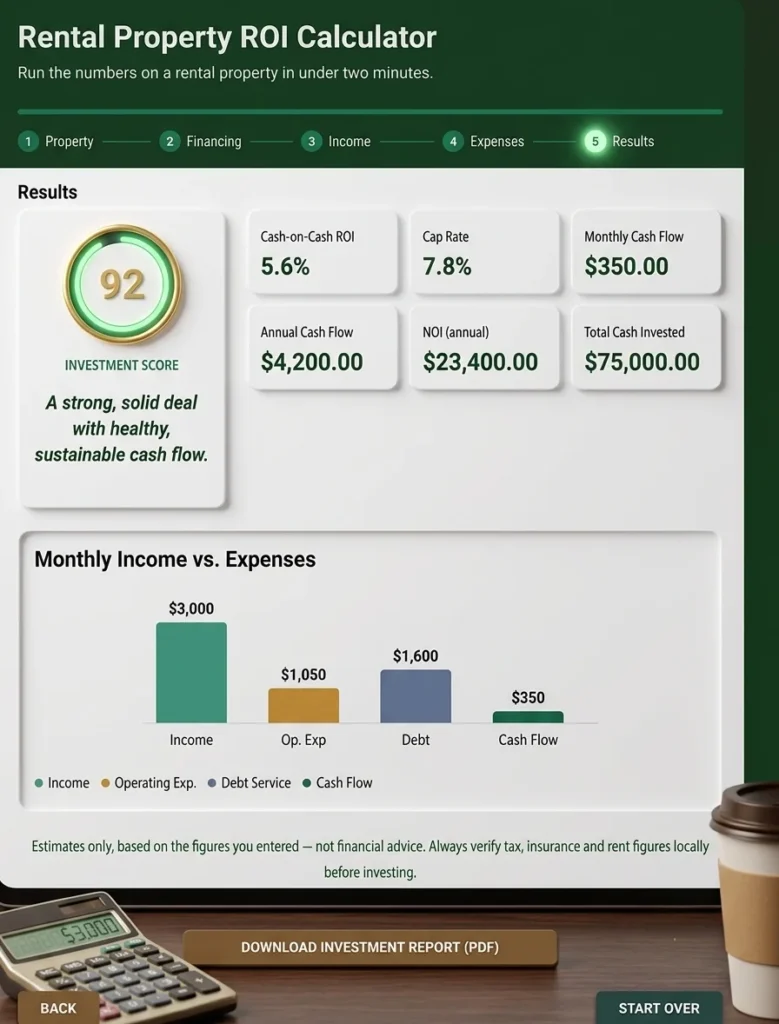
The Dollar Caffeine rental property calculator automates these steps, allowing you to input variables and get an instant report on NOI, Cap Rate, and CoC return, letting you focus on strategy rather than math.
Avoiding Common Investor Pitfalls
Even with a fast screening tool, beginners often fall into the same traps:
- Forgetting CapEx: Large, infrequent costs like roof replacements or HVAC systems will destroy your ROI if you don’t budget for them monthly.
- Over-Optimizing Rent: Always assume your property will sit vacant for a month every year.
- Ignoring Financing Costs: Don’t just calculate interest; include the impact of different loan products (FHA vs. Conventional vs. Jumbo).
- Buying for Appreciation Only: Market value is speculative. Cash flow is a reality. Never rely solely on the market going up to make a deal work.
FAQ: Frequently Asked Questions
Q: Is the 5-minute analysis enough for a final decision?
A: No. It is the first “filter.” If a property passes the 5-minute screening, then you proceed to deeper due diligence, such as physical inspections, title reviews, and neighborhood crime statistics.
Q: What is a good Cash-on-Cash return?
A: This varies by market. Generally, 8–12% is considered strong for a rental property.
Q: Should I include HOA fees in my analysis?
A: Absolutely. HOA fees are a recurring cost that directly reduces your net cash flow.
Q: How do I calculate “Net Operating Income” (NOI)?
A: NOI is your gross rental income minus all operating expenses, but before accounting for mortgage payments.
Conclusion: Start Screening Today
The ability to analyze a deal quickly is the difference between an amateur hobbyist and a professional real estate entrepreneur. By using our rental property calculator, you can remove the guesswork, eliminate emotional decision-making, and build a portfolio based on solid, data-driven performance.lator, you can remove the guesswork, eliminate emotional decision-making, and build a portfolio based on solid, data-driven performance.