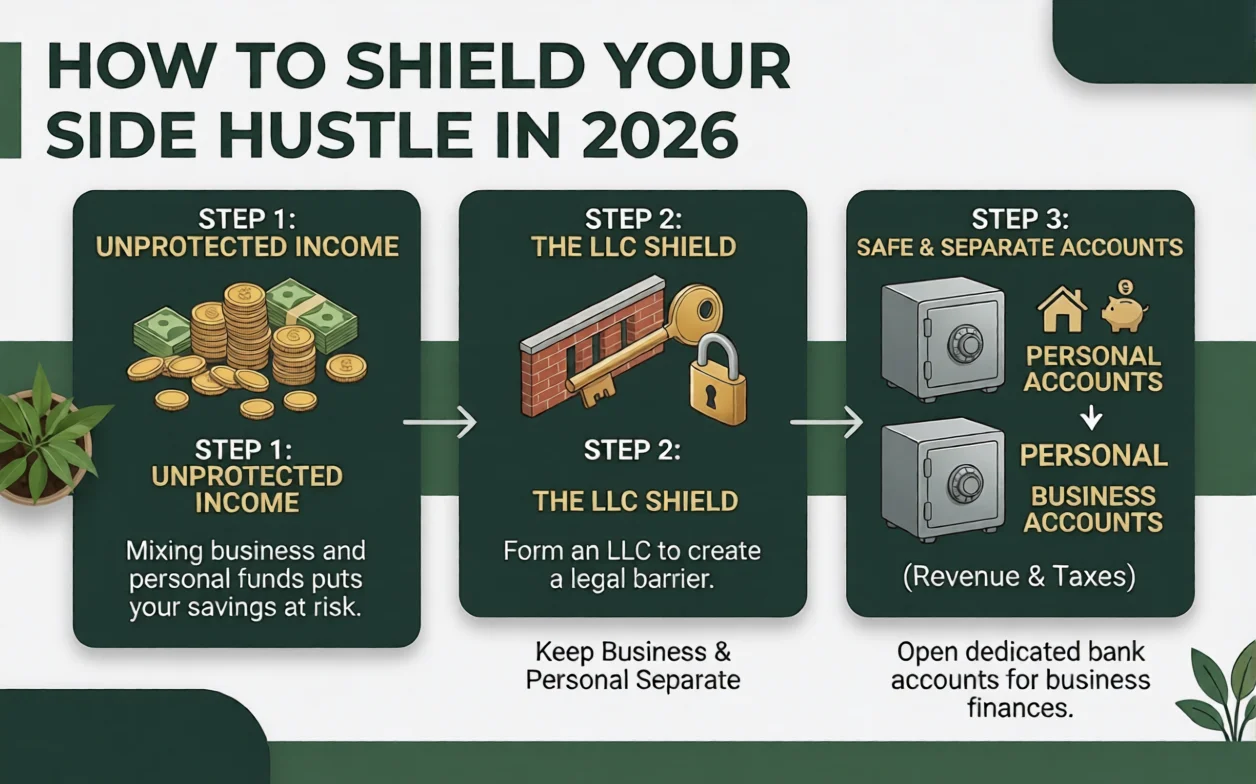
Mastering how to protect side hustle income in 2026 is the most critical financial skill you must execute this year to safeguard your growing wealth. Now that you have discovered the best platforms for freelancing and committed to tracking top secondary income streams, your operational focus must shift from pure revenue generation to strict asset protection. Gross revenue is completely meaningless if a surprise tax audit, an unexpected client non-payment issue, or a personal liability lawsuit completely drains your savings.
The modern freelance landscape has introduced a wave of complex regulatory changes. With tighter automated monitoring algorithms on digital payment apps and updated federal tracking guidelines, treating your side job like an informal, unrecorded hobby is an immediate financial risk. This guide provides a professional, step-by-step roadmap showing you exactly how to insulate your earnings using verified corporate structures, tactical banking habits, and ironclad contract terms.
The Regulatory Shift: Why Protecting Your Income Matters in 2026
The legal framework surrounding self-employment and secondary income streams has evolved rapidly. If you want to understand how to protect side hustle income in 2026, you must first master how regulatory bodies track your independent earnings.
Decoding the New $2,000 Form 1099-NEC Reporting Limit
Starting this fiscal year, corporate clients are only legally required to generate and file an official Form 1099-NEC for an independent contractor if total aggregate payments reach or exceed $2,000. This is a significant jump from the historic $600 baseline of previous years.
While this eliminates a massive amount of tedious paperwork for small businesses, it creates a dangerous psychological trap for solopreneurs. Many unverified online forums falsely claim that if a single client pays you less than $2,000, that income is completely tax-free. This is a dangerous misconception.
Critical Tax Mandate: According to official IRS Small Business Tax Guidelines, you are legally required to report all net self-employment earnings of $400 or more, regardless of whether a physical 1099 form was issued to you.
If you fail to manually log these smaller transactions, your vulnerability to automated Schedule C audits increases exponentially.
Mitigating the 15.3% Self-Employment Tax Trap
When you run an independent side business, you function simultaneously as both the employee and the employer. This means you are fully responsible for funding the total 15.3% Self-Employment Tax (SECA). This rate covers Social Security (12.4% up to the maximum wage base cap of $184,500) and Medicare (2.9%).
To cushion this financial blow, federal tax regulations allow you to calculate your self-employment tax base on 92.35% of your total net earnings, rather than your raw gross revenue. The formal tax calculation is structured using these two core formulas:
Taxable SE Base = Net Profit X 0.9235
Estimated SE Tax Liability = Taxable SE Base X 0.153
To evaluate exactly how different business formations, corporate revenue structures, and operating expenses mitigate your exposure to these financial liabilities, utilize our interactive analytical module below.According to IRC Gov.Business
2026 Side Hustle Tax Estimator
| Financial Metric | Calculation/Status |
|---|---|
| Gross Income | $5,000.00 |
| Business Expenses | $500.00 |
| Net Profit | $4,500.00 |
| Taxable Base (92.35%) | $4,155.75 |
| SE Tax (15.3%) | $635.83 |
| 1099 Compliance | 1099-NEC Required |
| Asset Protection Advice | Sole prop sufficient for scale |
Step-by-Step Checklist: How to Protect Side Hustle Income in 2026

Isolating your personal savings from your business obligations requires setting up clean corporate habits early. Follow this operational checklist to formalize your financial defense strategy.
roys the corporate shield.
1. Register a formal Limited Liability Company (LLC) via an accredited corporate processing group or directly through your local Secretary of State department. This step separates your personal assets from your business liabilities, ensuring your home, personal bank accounts, and personal property are entirely safe if your business faces a lawsuit or client dispute.
2. Apply for an Employer Identification Number (EIN) from the IRS and open a dedicated business checking account. All freelance payments, digital marketplace payouts, and app revenues must route exclusively into this corporate account. Never blend your personal cash with your business funds.
3. Set aside 25% to 30% of every client payment into an isolated savings sub-account immediately upon receipt. This ensures you maintain constant liquidity to handle your quarterly estimated tax payments (Form 1040-ES) seamlessly, preventing costly underpayment penalties from building up.
4. Never start working for a client based on a casual handshake or a verbal agreement. Use written service contracts that require a non-refundable upfront deposit or follow a structured milestone payment plan. Your standard contract should clearly state that you retain complete intellectual property ownership over your files until the final invoice is paid in full.
You can also check our Guide to Find out Top 10 Side Hustles in 2026
Advanced Contract Defense Strategies for Freelancers
A critical element of learning how to protect side hustle income in 2026 is securing your client agreements against late payments and non-payment risks. Handshake agreements provide zero legal protection when a client refuses to clear an outstanding invoice.
Implementing Strict Payment Terms and Intellectual Property Clauses
Your client contracts must always contain specific payment terms, such as a Net-15 or Net-30 payment window. To encourage timely payments, include a clear late-fee clause that applies a 1.5% to 2% compounding monthly interest charge to overdue balances.
Furthermore, insert an Intellectual Property (IP) Hold Clause. This legal safety net ensures that ownership of all digital assets, designs, code, or content transfers to the client only after the final invoice is settled in full. If a client attempts to use your deliverables without making final payment, they are guilty of copyright infringement, giving you powerful leverage to enforce settlement.
Shielding Assets via the Corporate Veil
To ensure that the courts respect your business entity, you must avoid the single biggest mistake small business owners make: commingling funds.
As detailed in the framework visual above, establishing a distinct corporate banking tracking system is not optional for limited liability structures it is the foundational element that prevents a creditor from “piercing the corporate veil.” If you pay personal bills directly out of your business checking account, your legal protection drops to zero.
Maximizing Your Legitimate Business Deductions
The most effective legal way to lower your financial vulnerability is to systematically reduce your net taxable income using legitimate write-offs. Ensure your accounting system tracks these primary categories:
Subscription Assets and Professional Tools
Claim a 100% deduction on all software platforms used to run your business. This includes:
- Accounting software and billing platforms
- Website hosting services and domain registrations
- Professional design tools and digital asset suites
- Virtual Private Networks (VPNs) and security software
The 2026 Standard Business Mileage Rate and Home Office Allocations
If your secondary business requires physical travel to meet clients, pick up supplies, or source inventory, track your mileage carefully. The official IRS standard business deduction rate is 72.5 cents per mile.
Additionally, if you have an exclusive, clearly defined area in your home used solely to run your side hustle, utilize either the simplified square-footage deduction layout or the actual expense calculation method to lower your overall tax burden significantly.
Frequently Asked Questions: Side Hustle Protection
Does an LLC reduce my side hustle income taxes?
No. A standard single-member LLC is a pass-through entity, meaning your business profits are taxed at your personal income tax rate. Its primary job is protecting your personal assets from business lawsuits, not reducing your tax bill. To reduce self-employment taxes as you scale, consult a professional about electing S-Corporation tax status.
How do I avoid piercing the corporate veil of my LLC?
Never mix personal and business funds. Keep entirely separate bank accounts, buy business assets only with company cards, and always sign your client contracts using your official LLC name rather than your personal name (e.g., Your Company LLC, By Your Name, Member).
What is the penalty for missing quarterly estimated tax payments?
If you expect to owe $1,000 or more for the fiscal year, the IRS charges an annualized underpayment penalty for missed deadlines. You must make regular quarterly payments using Form 1040-ES to avoid these compounding fees.
How do apps like PayPal and Venmo impact my side hustle taxes?
These platforms automatically report your business earnings (transactions marked as “Goods and Services”) directly to tax authorities via Form 1099-K when thresholds are crossed. Ensure you use a dedicated business profile on these apps to keep your personal transfers clean.