Everyone thinks you need big money to start investing. Like $5,000 or $10,000 just to open an account.
That’s bullshit. I started with $50 in college. My friend Sarah began with $25. Another buddy put in $100 and now has thousands.
The truth about how to start investing with $100 in 2025 is simple. You don’t need much cash. You just need to start.
This guide shows you exactly how to invest your first $100. Real platforms. Actual strategies. No fluff or get-rich-quick nonsense.
I’ll break down the best apps, safest investments, and biggest mistakes to avoid. Plus real stories from people who started small and built wealth over time.
Ready to put your money to work? Let’s do this.
Why $100 Is Actually Enough to Start
People always ask me: “Can $100 really make a difference?”
Hell yes it can. Here’s why.
Building the Investment Habit
Investing isn’t about having tons of cash. It’s about forming good habits.
When you start with $100, you learn how markets work. You see your money go up and down. You get comfortable with the process.
Most people who wait for “enough money” never actually start. They keep waiting for the perfect moment that never comes.
The Magic of Compound Growth
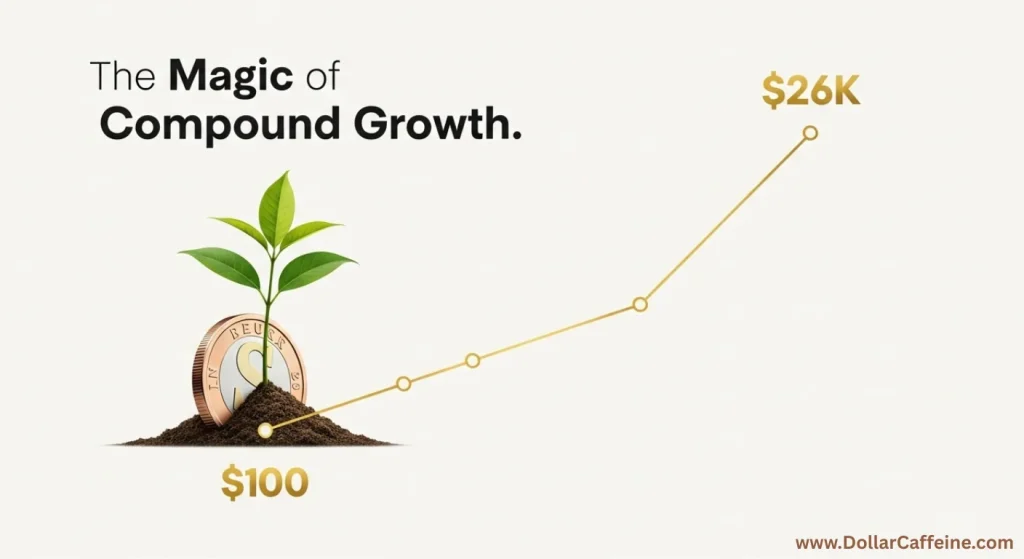
Small amounts grow into big amounts over time. It’s basic math.
Let’s say you invest $100 today. You add just $50 every month. After 20 years at 7% returns, you’d have over $26,000.
That’s from a tiny $100 start. Pretty cool, right?
Overcoming Investment Fear
I get it. Investing feels scary when you don’t know what you’re doing.
Starting with $100 removes that fear. If you lose it all (which is unlikely), you’re not going broke. You’re just out a hundred bucks.
But you’ll learn valuable lessons that help you invest bigger amounts later.
Time Is Your Best Friend
The earlier you start, the longer your money grows. A 22-year-old investing $100 beats a 40-year-old investing $1,000.
Time makes small amounts turn into life-changing wealth.
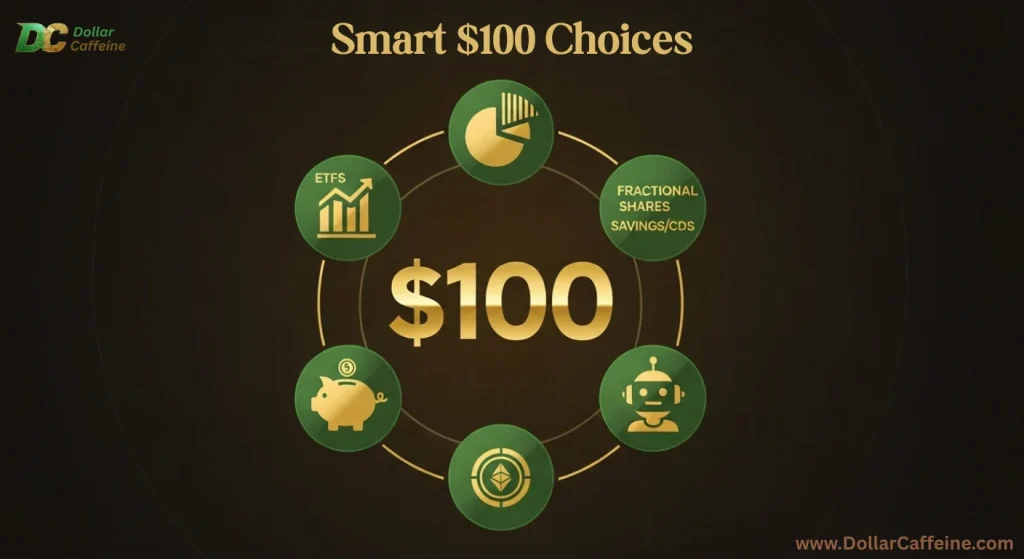
Best Ways to Invest $100 in 2025
So where should you put that $100? Here are your best options.
Index Funds and ETFs
This is where I’d put my money if starting over.
Index funds buy tiny pieces of hundreds of companies. Instead of betting on Apple or Tesla, you own a slice of the entire stock market.
Popular choices:
- SPHD (S&P 500 fund)
- VTI (Total stock market)
- QQQ (Tech-heavy fund)
Why I love ETFs: They’re diversified. If one company tanks, 499 others keep you afloat.
Fractional Stock Shares
You used to need $400 to buy one Amazon share. Now you can buy $10 worth.
Fractional shares let you own pieces of expensive stocks. With $100, you could own parts of:
- Apple ($10)
- Microsoft ($15)
- Tesla ($20)
- Google ($25)
- Amazon ($30)
Boom. You own five major companies for $100 total.
High-Yield Savings and CDs
Not exciting, but safe as hell.
High-yield savings accounts pay 4-5% right now. CDs (certificates of deposit) lock your money for guaranteed returns.
Your $100 won’t make you rich here. But it won’t disappear either.
Good for ultra-conservative beginners who can’t handle any risk.
Target-Date Funds
These funds adjust automatically as you age. When you’re young, they buy more stocks. As you get older, they shift to bonds.
Perfect for lazy investors who want to set it and forget it.
Cryptocurrency (Small Amounts Only)
Crypto is still wild in 2025. Bitcoin, Ethereum, and others swing up and down like crazy.
I’d put maybe $20 of your $100 here. Not more. Crypto can make you rich or broke. Usually broke.
But a small amount gives you exposure without risking everything.
Robo-Advisors
These are computer programs that invest for you. You answer some questions about your goals and risk tolerance. They build a portfolio automatically.
Popular robo-advisors:
- Betterment
- Wealthfront
- M1 Finance
Great for beginners who don’t want to pick individual stocks.
Step-by-Step Guide: Your First $100 Investment
Here’s exactly how to get started. No confusion, no overwhelm.
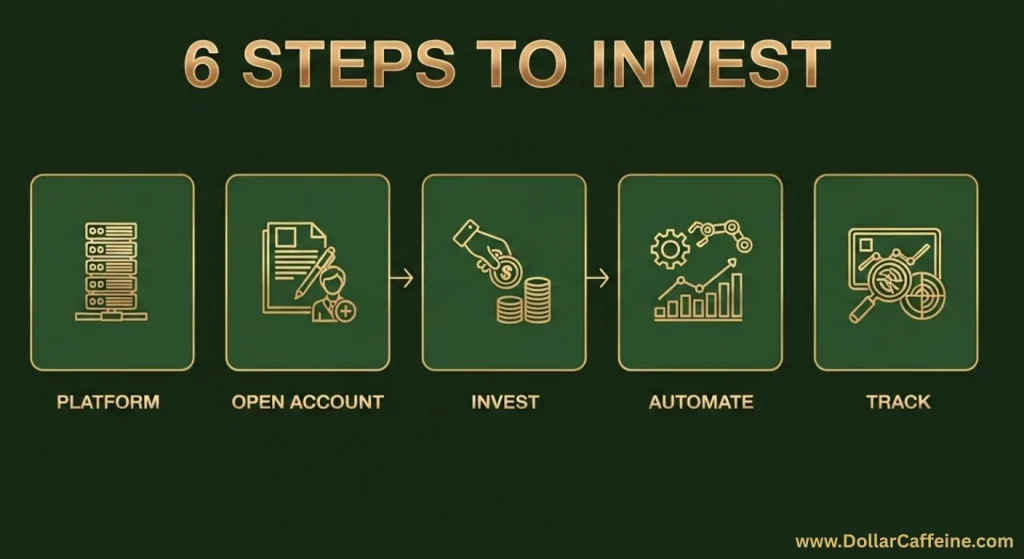
Step 1: Pick Your Platform
You need somewhere to actually buy investments. Here are the best way to invest $100 platforms:
For Total Beginners:
- Acorns (rounds up purchases, invests spare change)
- Stash ($5 minimum, educational content)
- Robinhood (free trades, simple interface)
For Slightly More Advanced:
- Fidelity (no account minimums, great research)
- Charles Schwab (excellent customer service)
- Vanguard (low-cost index funds)
I’d start with Fidelity or Schwab. Both are free and have tons of investment options.
Step 2: Open Your Account
This takes about 10 minutes online. You’ll need:
- Social Security number
- Bank account info
- Driver’s license or ID
- Employment information
Most places approve you instantly. Some take 1-2 days.
Step 3: Deposit Your $100
Link your bank account and transfer the money. Usually happens same day.
Don’t stress about timing the market. Just get the money in there.
Step 4: Choose Your First Investment
For beginners, I recommend starting simple:
Option A: Put all $100 in an S&P 500 index fund Option B: Split between 2-3 different ETFs Option C: Buy fractional shares of 5-10 companies you know
I’d go with Option A. Simple, diversified, historically reliable.
Step 5: Set Up Automatic Investing
This is crucial. Set up $25 or $50 monthly deposits. Even $10 helps.
Automatic investing removes emotions and builds wealth steadily. Most successful investors do this.
Step 6: Track Progress (But Don’t Obsess)
Check your account once a month. Not daily. Daily checking makes you crazy and leads to bad decisions.
Your $100 will go up and down. That’s normal. Stay calm.
Common Beginner Mistakes (And How to Avoid Them)
I’ve seen people make the same errors over and over. Learn from their pain.
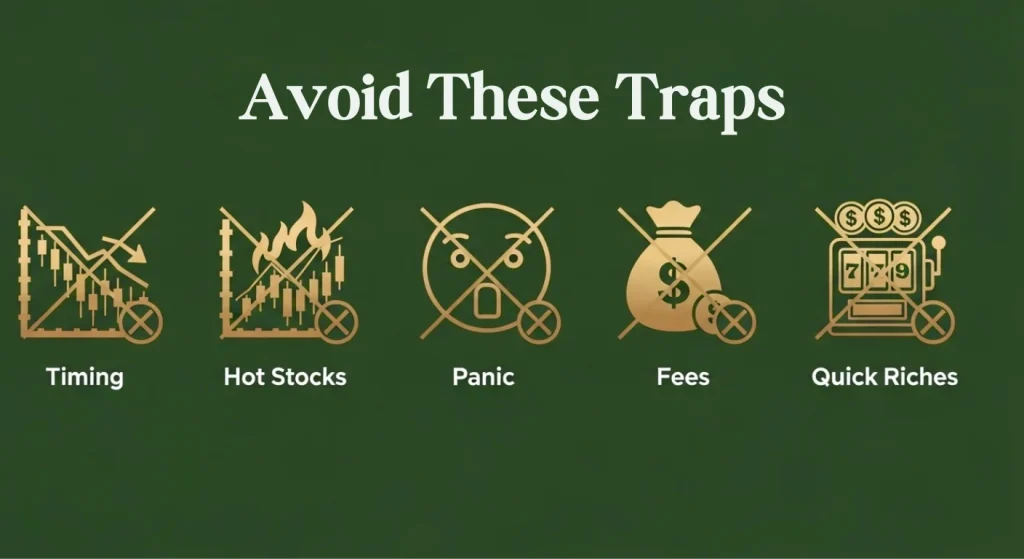
Chasing Hot Stocks
Don’t put all $100 into whatever stock is trending on Reddit or TikTok.
Hot tips usually turn into cold losses. Stick with boring, diversified investments.
Trying to Time the Market
“I’ll wait for the market to drop, then invest.”
Nobody can predict short-term market movements. Not professionals, not gurus, not your smart friend.
Just invest your $100 now. Time in the market beats timing the market.
Not Diversifying
Putting all $100 in one company is gambling, not investing.
If that company fails, you lose everything. Spread your money across multiple investments.
Panic Selling
Markets go down sometimes. When they do, beginners freak out and sell everything.
This locks in losses and kills long-term growth. When markets drop, buy more if you can. Don’t sell.
Ignoring Fees
Some platforms charge $5-10 per trade. That’s 5-10% of your $100 gone instantly.
Use free trading platforms like Fidelity, Schwab, or Robinhood. Every dollar counts when you’re starting small.
Expecting Quick Riches
Investing isn’t a lottery ticket. You won’t turn $100 into $10,000 in a year.
Real wealth building takes time. Think years and decades, not weeks and months.
Best Micro-Investing Apps for 2025
Technology makes invest in stocks with little money easier than ever. Here are the top apps:
Acorns
Rounds up your purchases to the nearest dollar. Invests the spare change automatically.
Buy coffee for $3.50? Acorns invests the 50 cents.
Pros: Completely automatic, great for people who can’t remember to invest Cons: $3 monthly fee (expensive for small accounts)
Stash
Educational platform that teaches while you invest. $5 minimum to start.
Pros: Great learning tools, fractional shares available Cons: $3 monthly fee, limited investment options
Robinhood
Free stock and crypto trading. Simple interface, instant deposits.
Pros: No fees, easy to use, fractional shares Cons: Limited research tools, had some reliability issues
Fidelity
Traditional brokerage with no account minimums. Excellent research and tools.
Pros: No fees, amazing customer service, thousands of investment options Cons: Interface can be overwhelming for total beginners
M1 Finance
Automated investing with customizable portfolios. You pick the investments, M1 handles the rebalancing.
Pros: Free automated investing, fractional shares, flexible Cons: Learning curve for beginners
I’d recommend Fidelity for most people. Free, reliable, and you won’t outgrow it as your account gets bigger.
What Experts Say About Small-Amount Investing
Warren Buffett’s Advice
The world’s greatest investor recommends index funds for beginners. He says most people should buy the S&P 500 and hold forever.
His exact words: “Put 10% of the cash in short-term government bonds and 90% in a very low-cost S&P 500 index fund.”
Suze Orman’s Take
Popular financial advisor Suze Orman pushes people to start investing young, even with tiny amounts.
She says the habit matters more than the amount. Starting with $100 builds discipline for larger investments later.
Reddit Success Stories
The r/investing community is full of people who started small:
- User “SmallInvestor22” turned $200 into $15,000 over 8 years through consistent monthly investing
- “BrokeCollegeKid” started with $50, now has $25,000 after 10 years of regular contributions
- “SingleMom403” began with $100 and built a $40,000 portfolio over 12 years
Source: Reddit Investing Community
Professional Financial Planners
Most certified financial planners agree: starting early with small amounts beats waiting for large amounts.
The National Association of Personal Financial Advisors says time is more important than money when building wealth.
Source: NAPFA Guidelines
People Also Ask
Can you really start investing with just $100?
Absolutely. Many brokerages have no minimum balance requirements in 2025. You can buy fractional shares of expensive stocks and diversified ETFs with $100.
What’s the safest way to invest $100?
Index funds and ETFs are safest for beginners. They spread risk across hundreds of companies. If one company fails, others keep your investment stable.
How much can $100 grow in 10 years?
Assuming 7% annual returns (historical stock market average), $100 would grow to about $197 in 10 years. Add $50 monthly, and you’d have over $8,000.
Should I put my $100 in crypto?
Maybe $10-20, but not the whole amount. Crypto is extremely volatile. You could double your money or lose it all. Start with safer investments first.
Do I need a financial advisor for $100?
No. Most advisors require $10,000+ minimums. At $100, use low-cost index funds and robo-advisors. Learn the basics yourself first.
Which app is best for investing $100?
Fidelity and Charles Schwab offer the most options with no fees. Acorns is good for automatic investing. Robinhood works for simple stock purchases.
How often should I check my $100 investment?
Once a month maximum. Daily checking leads to emotional decisions and stress. Set up automatic investing and let time do the work.
Can I lose all my $100 investing?
It’s possible but unlikely with diversified investments like index funds. Individual stocks can go to zero, but broad market funds have never lost everything long-term.
Advanced Strategies for Growing Your $100
Once you’ve invested your first $100, here are ways to accelerate growth:
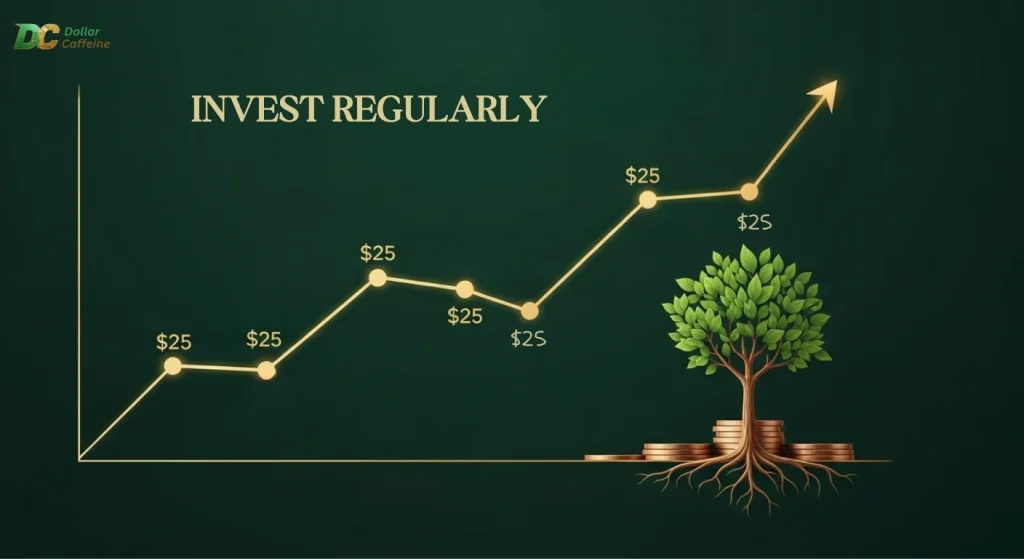
Dollar-Cost Averaging
Invest the same amount regularly regardless of market conditions. $25 every week or $100 monthly.
This smooths out market volatility and builds wealth steadily. Most millionaire investors use this strategy.
Reinvest All Dividends
When your investments pay dividends, reinvest them automatically. This compounds your growth over time.
A $100 investment paying 2% dividends becomes $102. Next year, that $102 earns dividends on the full amount.
Increase Contributions Gradually
Start with $100, then add $10-50 monthly. When you get raises at work, invest part of the extra income.
This slow increase doesn’t hurt your budget but dramatically improves your investment growth.
Tax-Advantaged Accounts
Once you have steady income, consider IRAs or 401(k)s. These accounts offer tax benefits that boost your returns.
A Roth IRA lets your $100 grow tax-free forever. Traditional IRAs give you tax deductions now.
Rebalancing Your Portfolio
As your investments grow, some will become larger portions of your portfolio. Sell some winners and buy more losers to maintain balance.
This forces you to buy low and sell high automatically.
Common Pitfalls and How to Avoid Them
Analysis Paralysis
Some beginners research for months without ever investing. They want the “perfect” investment.
There’s no perfect investment. Good enough is good enough. Start with an S&P 500 fund and learn as you go.
Emotional Investing
Markets crash. When they do, scared investors sell everything and lock in losses.
Successful investors buy more during crashes. Your $100 investment will fluctuate. Stay calm and keep investing.
Lifestyle Inflation
As you earn more money, you spend more money. Your investing doesn’t keep pace.
Combat this by automatically increasing investment contributions when your income rises.
Neglecting Emergency Funds
Don’t invest your last $100 if you have no emergency savings. Build a small emergency fund first, then invest.
You need 3-6 months of expenses saved before investing becomes the priority.
Comparing Yourself to Others
Social media makes everyone look like investing geniuses. Don’t compare your $100 start to someone’s $50,000 portfolio.
Everyone started somewhere. Focus on your own progress and goals.
Your Action Plan: Next Steps
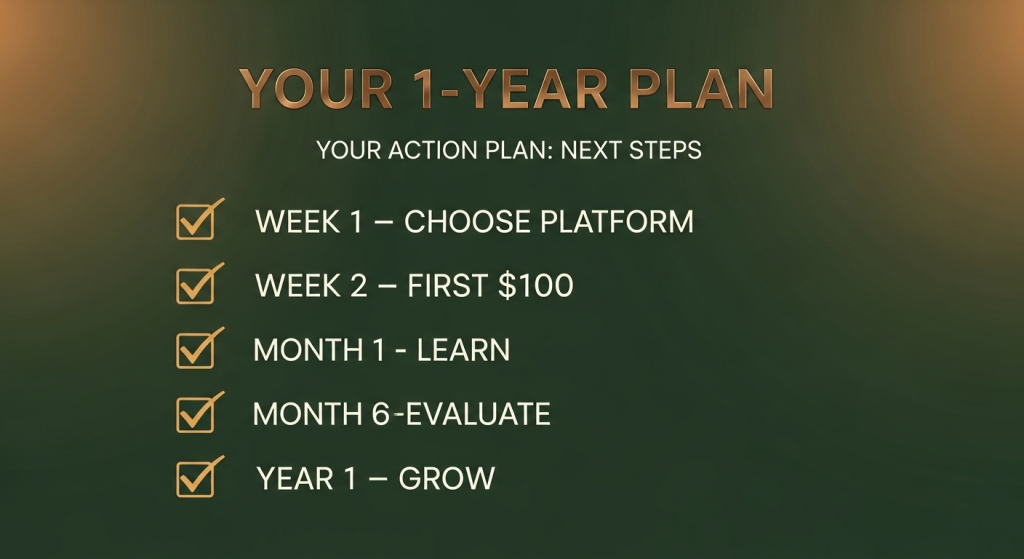
Week 1: Research and Choose
Spend a few hours researching platforms. Read reviews, compare fees, check available investments.
Pick one platform and open an account. Don’t overthink this decision.
Week 2: Make Your First Investment
Deposit your $100 and buy your first investment. I recommend starting with an S&P 500 index fund.
Set up automatic monthly contributions, even if it’s just $10-25.
Month 1: Learn and Adjust
Read investing books, watch YouTube channels, follow financial blogs. But don’t change your strategy constantly.
Popular resources:
- “The Simple Path to Wealth” by JL Collins
- Bogleheads community forum
- Ben Felix YouTube channel
Month 6: Evaluate Progress
Check your investment performance. Are you sticking to your monthly contributions? Are you comfortable with the volatility?
Adjust if needed, but don’t panic over short-term losses.
Year 1: Expand Your Knowledge
Consider adding international stocks or bonds to your portfolio. Maybe increase your monthly contributions.
You’ve built the habit. Now you can optimize and grow.
Final Thoughts
How to start investing with $100 in 2025 isn’t complicated. You don’t need perfect timing, perfect knowledge, or perfect amounts.

You just need to start.
I’ve seen too many people wait years for the “right moment” to begin investing. Meanwhile, inflation eats their savings and opportunities pass by.
Your $100 might seem small now. But it’s the foundation for everything that comes after. The habits you build, the knowledge you gain, the confidence you develop – these matter more than the initial amount.
The stock market has created more wealth for ordinary people than any other system in history. But only for people who actually participate.
Don’t be the person who looks back in 20 years wishing they’d started sooner. Be the person who looks back grateful they began with just $100.
Your future wealthy self is counting on you to take action today.
Read more about finance on Dollar Caffeine